

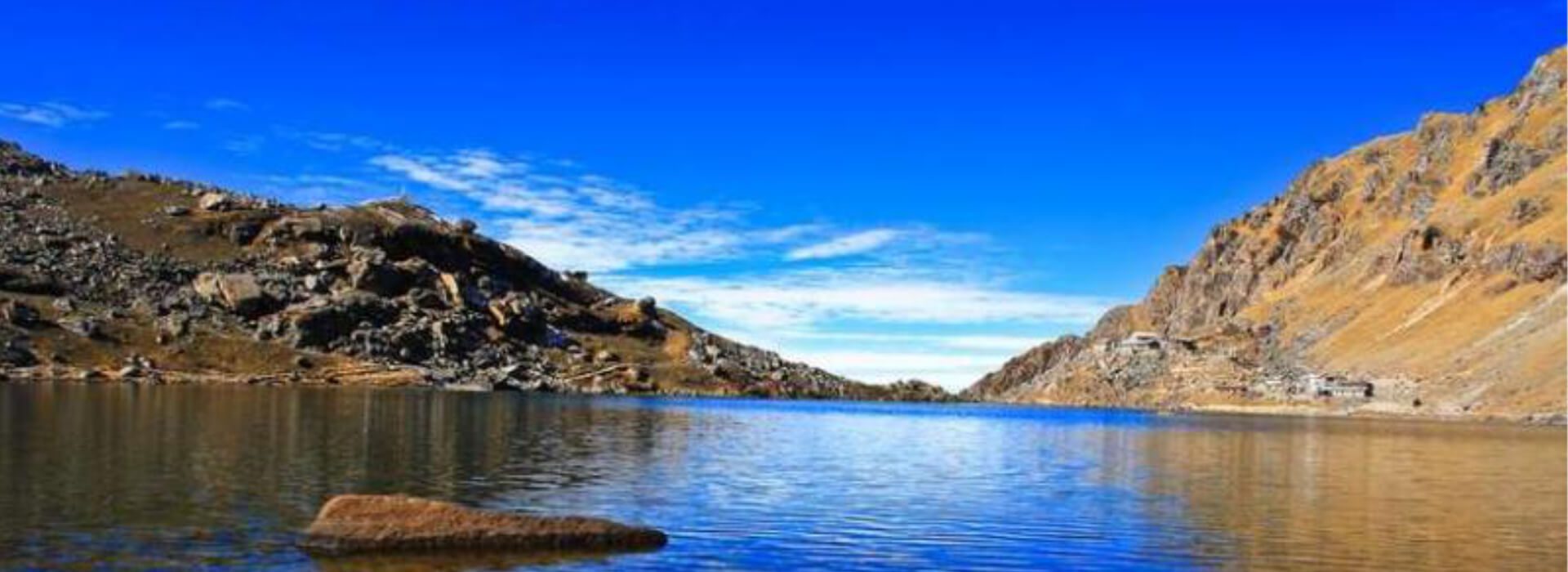
Gosaikunda Helambu Trek – 11 days


 Trip Duration
 Group Size
 Max. Altitude
 Difficulty
 Meals
Meals
- 12 Breakfast
- 9 Lunch
- 10 Dinner
 Accommodation
- 3 Nights Hotel
- 8 Nights Lodge
 Activities
- Trekking
- Sightseeing
- Hiking
 Best Season
- Sep – Dec
- Mar -April
- May – June
You can talk with our travel experts for departure dates and price details.
- Private trip departures everyday
- No hidden cost
- Local based company
- We can help for big group
- Over 17 years of experience
- According to your needs, we can Customize the itinerary.

Itinerary of Gosaikunda Helambu Trek – 11 days
| Day | Mode | Route Itinerary | Elev.(m) | Duration | Overnight | Included |
|---|---|---|---|---|---|---|
| 01 | Flight | Arrive Kathmandu - Hotel | 1300 | ----- | Hotel | D |
| 02 | Tour | Kathmandu - Sightseeing | 1300 | 6/7 hrs | Hotel | B |
| 03 | Drive | Kathmandu - Dhunche | 2030 | 6/7 hrs | Guest House | B L D |
| 04 | Trek | Dhunche - Sing-Gumpa | 3250 | 5/6 hrs | Guesthouse | B L D |
| 05 | Trek | Sing-Gumpa - Lauribinayak | 3660 | 4/5 hrs | Guesthouse | B L D |
| 06 | Trek | Lauribinayak - Gosaikunda | 4380 | 4/5 hrs | Guesthouse | B L D |
| 07 | Trek | Gosaikunda - Lauribina Pass - Ghopte | 4682/3640 | 7/8 hrs | Guesthouse | B L D |
| 08 | Trek | Ghopte - Melamchi Gaon | 3100 | 5/6 hrs | Guesthouse | B L D |
| 09 | Trek | Melamchi - Tarkeghyang - Sermathang | 2500 | 5/6 hrs | Guesthouse | B L D |
| 10 | Trek/drive | Sermathang - Melamchi - Kathmandu | 1300 | 6/7 hrs | Hotel | B L |
| 11 | Flight | Kathmandu - Own Country | ----- | ------ | ------ | B |
Includes/Excludes
What's included
- Airport pickup and drop services by private vehicle including before and after the trek
- Accommodation in Kathmandu as per the itinerary / with complimentary breakfast
- All ground transportation by private vehicle in city
- Kathmandu – Dhunche and Melamchi – KTM by Local bus (optional private jeep)
- All required trekking permits and necessary paper works
- 3 meals (Breakfast, Lunch and Dinner) during trek
- Accommodation in lodge/guest houses during the trek
- License -Trekking Guide with his all expenses and insurances
- Assistant trekking guide for groups over 6 people with his all expenses and insurance
- Strong porters ( 2 trekkers = 1 Porter) with his all expenses and insurances
- Down jacket, sleeping bag to use in trekking
- Free trekking map and Ambition Himalaya T-shirt
- First aid medications / medicines with the guide
- Necessary paper works, government and local taxes, company service charges
- Complementary welcome dinner in Kathmandu at a typical Nepali restaurant
- Certificate of Achievement signed by director of the company and your guide
What is excluded
- International Airfares, Visa Fees,($ 30 for 15 days, $ 50 for 30 days and $ 125 for 90 days)
- Travel and Rescue Insurance, Emergency Evacuation
- Bars and Beverage bills, cold drinks, mineral water,
- Tea – coffee ,hot shower, telephone bills, laundry
- Extra activities than mentioned in the itinerary, extra porter charges
- Lunch and Dinner in Kathmandu [Meals not included also in the cases of early returns from the trips]
- Extra accommodation caused due to early arrival, flight delays, natural disasters etc.]
- Tips / Gratitude for Guides and Porters
- Any services not mentioned in Service Includes Section unless specified on booking of the trekking
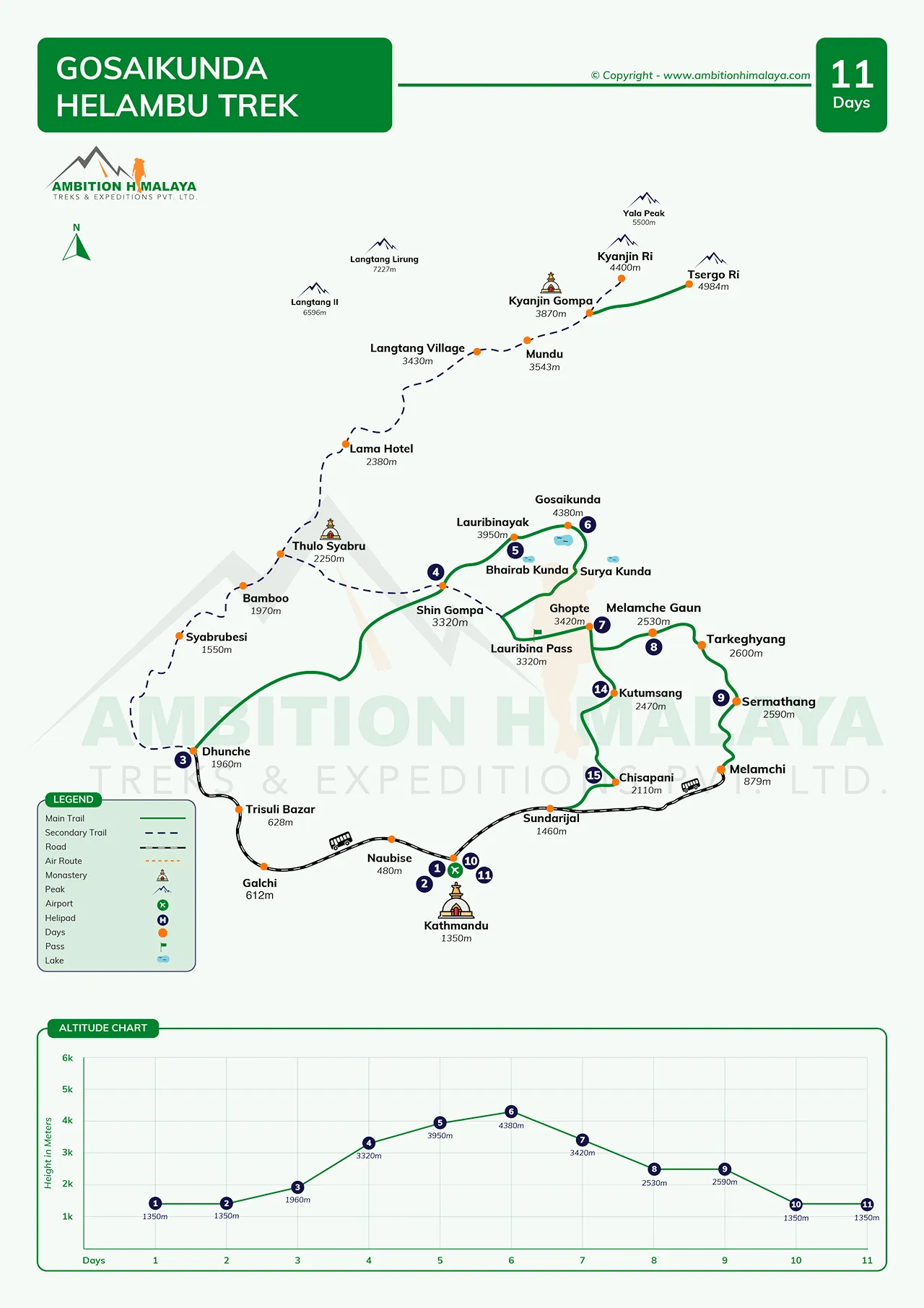
Route Map & Altitude Chart
Trip Information
Best Time
Gosaikunda Helambu Trek is more likely to be done between March and May during the spring and September to November during autumn. These are the best trekking seasons of the Himalayas, and they are stable and pleasant. In the spring, the trails are covered with blooming rhododendrons, and the woods are fresh and colorful. The days are sunny and mild, with cool nights, which is ideal for walking and seeing the mountain scenery.
The other best period is the fall, which has crystal clear skies and calm weather, and the Langtang and Ganesh Himal ranges are marvelously visible. The climate is not hot, and the possibility of precipitation is minimal. This season is also associated with a series of local festivals, which means that trekkers can have a glimpse of the Nepali culture during the route.
The monsoon between June and August has a lot of rainfall, slippery roads, and landslides, thus rendering trekking challenging. Nevertheless, the valleys become green and fertile, and it does not disgust those who do not mind the wet climate. During winter, from December to February, it is quite cold, particularly above the Lauribina Pass, where snow usually covers the trail or closed.
In case you like colored forests and average temperatures, then spring is your choice. Autumn is your season in case you like fresh air, sharp mountain outlooks, and celebrations. The two seasons have their own beauty; however, the season that is less risky and more rewarding is autumn, which the Gosaikunda Helambu Trek is said to have.
Elevation and Distance
Gosaikunda Helambu Trek starts at the little town of Dhunche, 2,030 meters high, in the Rasuwa district. It moves on progressively, up through pine and rhododendron forests, through villages such as Sing Gompa and Lauribinayak, to the holy Gosaikunda Lake. The summit of the trek is the Lauribina Pass, which is 4,610 meters above sea level.
The trail then gradually descends from the pass through Ghopte, Melamchi Gaon, and Sermathang, and back to Kathmandu at 1,350 meters. The overall trekking distance is approximately 70 to 85 kilometers, depending on the specific route of the trek and the side trips made in the process.
The height also varies greatly during the trip, and this impacts the rate of walking as well as the landscape. The upper areas have low forests and falls, and dense forest and terraces over the lower parts. The trees become sparse as you get up the mountain, and the road turns stony with clear views of the mountains.
The air becomes colder and less humid towards the pass, and thus, trekkers are recommended to walk very slowly and take acclimatization breaks.
Due to these slow ascents and descents, the Gosaikunda Helambu Trek is a good combination of difficulty and splendor. The gradual climb up to Dhunche and down to the valley of the Helambu makes every day a new experience as the scenery, culture, and mountain lifestyle keep changing.
Difficulty and Altitude Sickness
The Gosaikunda Helambu Trek is described as moderate to difficult due to steep ascents and elevation. The route also has some flat areas and strenuous climbs, particularly where one is nearing Lauribina Pass. This does not demand technical climbing, but the trekkers must have good endurance and mental strength to sustain days of long walks and different terrains.
The route is quite manageable for the majority of trekkers whose fitness is at a basic level. The daily walking hours is manageable, and the number of tea houses where one can rest and have a meal is sufficient. The slow increase in altitude also contributes to the natural adaptation of the body to the light air. It is better to do things gradually and at a steady pace.
After getting high and above 3,500 meters, it is possible to have mild symptoms of altitude sickness which are headaches, dizziness, loss of appetite, and fatigue. These tend to be seen in case you climb too quickly without adequate rest.
In order to remain safe, one should drink lots of water, eat healthy, and take short breaks. Alcohol and smoking should be avoided because they dehydrate the organism and exacerbate the symptoms. Acclimatization can be done by spending an additional night at an intermediate place such as Sing Gompa.
As this hiking journey is more or less 4,700 meters, travel insurance with high altitude trekking cover and helicopter evacuation is highly advised. It keeps you safe in case of an emergency and provides tranquility as you go sightseeing on one of the beautiful highways in Nepal.
Maximum and Minimum Walk per Day.
In the Gosaikunda Helambu trek, the average number of hours trekkers keep walking daily is 5 to 7 hours. The time varies depending on the route of the day and the elevation gain. Other days are more or less stressful, whereas others are long and physically challenging.
Amongst the days that could be taken as being easy is the one between Lauribinayak and Gosaikunda, which lasts approximately 4 to 5 hours of steady uphill climbing. The most challenging day is between Gosaikunda across Lauribina Pass to Ghopte, which may be taken up between 7 to 8 hours.
In this part, there is a high pass of approximately 4,610 meters after which it descends steeply through rocky and forested views.
The walking conditions are different; you will go through the stone steps, small forest trails, and rocky, high-alpine terrain. One should maintain a slow and steady pace, with frequent short breaks to rest his/her legs and be hydrated. Getting up early in the mornings prevents fatigue in the afternoons, and a day of trekking becomes smoother.
Accommodation
During the Gosaikunda Helambu Trek, the majority of the accommodation is in teahouses and guesthouses. These lodges are plain but cozy, and they serve to offer a good rest to the trekkers after a hard day on the trail.
In the rural areas, such as Sing Gumpa, Lauribinayak, and Ghopte, accommodation is simple, with common bathrooms and clean bedding. Hot water is limited and sometimes unavailable, so it is a good idea to have a small towel and be ready to take cold showers in the higher elevations.
Their lodging places have small dining rooms that have fireplaces or wood burners to make you feel nice during the cold evenings. The food is taken in common rooms where the trekkers get to socialize and exchange stories, thus making the experience social and comfortable.
In locations such as Dhunche and Kathmandu, there are more contemporary accommodation facilities, and the accommodation facilities are private, have hot water that is reliable, and have better facilities. Most lodges along the trek have electricity and charging points which can be accessed, but in isolated areas, electricity can only be supplied for a few hours a night.
Solar charging of phones and cameras is also provided in many lodges, although a power bank is advisable to keep. All in all, the Gosaikunda Helambu Trek is adequately accommodated to stay in, and you will also experience Nepali hospitality in local village lodges.
Foods and Drinks
During the Gosaikunda Helambu Trek, the trekkers will be served with a combination of Nepali traditional cuisine and basic international food. A nutritious meal to be taken along the trail is the staple food called Dal Bhat, which refers to a mixture of rice, lentils, and vegetables usually accompanied by pickles.
There are also other popular dishes like noodles, soups, pancakes, and omelettes, and the hot drinks such as tea, coffee, or hot chocolate that would keep you warm when it is chilly mornings and evenings.
Vegetarian alternatives are also famous, and the majority of the teahouses can handle special dietary requests provided beforehand. Nonetheless, more remote locales, such as Gosaikunda and Ghopte, might have fewer options, and thus it is better to prepare in advance and bring something to eat. Energy bars, chocolates, and dried fruits carried in Kathmandu will be useful during the long trekking days to give energy quickly.
Lodges usually have clean drinking water; however, to prevent contracting water-borne diseases, it is advisable to purify it with purification tablets or a water filter. Limit alcohol and excessive caffeine, as these may end up dehydrating the body in addition to exacerbating the symptoms of the altitude at higher levels.
In general, the food on the Gosaikunda Helambu Trek is very basic, nutritious, and nourishing. Trekkers are given an opportunity to experience the local tastes authentically, yet have a well-balanced diet to keep them going through the strenuous walks and up the mountain peaks. Dining together with other trekkers in the small eating rooms also brings out a social, homely touch to the trip.
Alternative Routes
The Gosaikunda Helambu Trek has a number of other routes that can be taken as per time, fitness level, and interests. An alternative would be the Langtang Valley + Gosaikunda Trek, a more extended route that will combine the picturesque Langtang Valley with the holy Gosaikunda Lake. This is the path that trekkers desire to get a deeper experience of having to view more of the mountain, have a cultural experience, as well as have more days on the trek.
The Short Gosaikunda Trek is a 5–7-day version, meant to be used as an alternative by the time-strapped, with the main aim of getting to Gosaikunda Lake and back via Lauribina Pass or the reverse. The choice is good when an amateur or a tourist wishes to experience the high-altitude hiking without having to spend 11 days on the trek.
The other one is the Helambu Circuit Trek, which is not on the same route as the Gosaikunda part but on the villages of Helambu. This is a comprehensive cultural adventure, with the average days of moderate walking and sufficient socialization with locals.
Depending on your priorities, if you want both mountain views and sacred lakes, choose the longer combined route. The Helambu Circuit is best suited for case who are interested in culture and village life. The shorter hikes are ideal in cases where an individual wishes to have a quick trip to the alpine scenery without taking extensive hikes.
Can a Beginner Join this Trip?
Yes, first-timers may take part in the Gosaikunda Helambu Trek, as long as they are fairly fit and they train beforehand. The trek is of a moderate level, with stable ascents and a comfortable number of hours to walk daily, which is why it is suitable for beginner trekkers. Crossing Lauribina Pass is the most difficult, but with a good pace and acclimatization, even amateurs can do it safely with proper acclimatization, pacing and guidance.
The beginners must train by undertaking regular cardio workouts, hill climbing, or mini hikes to develop stamina. Travelling with minimal equipment and knowing simple trekking skills, such as utilizing trekking poles and pacing on a steep mountain, makes the trip easier. This trek has a great number of guides and porters willing to help with navigation, carry luggage, and give local information.
Although the trek involves numerous problems with altitude, the trek is deemed to be user-friendly since the climb is gradual and the body will adapt naturally. The trail has teahouses that provide rest stops, meals, and warm shelters, which contribute to the level of comfort.
Through proper planning, a gradual rate, and under the tutelage of mature personnel, even the novice trekkers will find the Gosaikunda Helambu Trek, with all its scenic beauty and cultural wealth, without having to stretch to undue lengths.
Preparation and Fitness
To enjoy the Gosaikunda Helambu Trek in a comfortable way, proper preparation and fitness are important. A trek at higher altitudes means a few days of walking, climbing steep ascents, and traversing steep passes; thus, cardiovascular endurance should be developed.
Running, cycling, swimming, or vigorous cardio workouts 3-4 times a week can assist in enhancing stamina. It is also important to build your leg muscles with the help of squats, lunges, or stair climbing, as these are also the muscles that will power you hill and give you some stability in two legs on uneven surfaces.
Practice hikes with a loaded backpack before the trek is very helpful. About a 3–5-hour trek on the hills or trails near your area will stimulate the trekking condition and aid in your body becoming accustomed to the weight load distribution across uneven surfaces. Hiking up a hill or raising the hiking distance slowly will condition your body for multi-day treks, particularly when traversing Lauribina Pass.
The correct equipment is a big deal. The necessities are trekking poles, durable waterproof boots, layered clothing according to different temperatures, a quality rain jacket, gloves, a hat, a comfortable backpack, etc. There will also be a need for a water bottle, snacks, and a first-aid kit.
It is also important to prepare mentally. Trekkers should be mentally prepared for unpredictable weather, frosty nights, and primitive conditions in tropical teahouses. Patience, flexibility, and a positive attitude allow one to deal with situations that arise without planning, such as delays at the trail or poor amenities. Through enough physical and psychological training, the Gosaikunda Helambu Trek would be a safe, enjoyable, and memorable experience.
Gadget, Mobile, and Internet
In the Gosaikunda Helambu Trek, electricity is usually present in most of the teahouses, although it can be cut off and supplied by solar power panels at isolated locations. Depending on the lodge, certain lodge services can impose a fee to charge their devices, but again, it can be 100 to 300 NPR on a per-lodge basis. However, a backup such as a power bank is a good idea, particularly during long trekking days or high-altitude rests in the event that power is unavailable.
Wi-Fi is available but slow in lower sections like Dhunche and Sing Gompa, and is unreliable beyond Lauribina. Most of the trail is part of the mobile networks, such as NTC and Ncell, although at higher altitudes and in forested valleys, the signal becomes weak.
The trekkers would have to schedule the use of the devices to a minimum of calls, GPS, or photos. Offline maps, as well as pre-downloaded content, are beneficial. On the whole, there is less connectivity; however, it is one of the charms of trekking beyond where you can forget about the world and listen to the beauty of nature in the Gosaikunda Helambu Trek.
Permit
The Gosaikunda Helambu Trek needs two significant permits in order to be safe and conserve nature. The first is the Langtang National Park entry permit, which enables one to enter and hike in the safeguarded zone. The second is the TIMS Card (Trekkers Information Management System), which assists the authorities in tracking trekkers to ensure their safety. These two permits are compulsory for all trekkers.
One may take such permits at Kathmandu before the commencement of the trek or at Dhunche, which is the gateway to Langtang National Park. The Langtang National Park permit is approximately 3,000 NPR when paid by foreign nationals, and the TIMS card is about 2,000 NPR for foreigners and NPR 1,000 for SAARC nationals.
One should bring copies of both permits, as well as the original ones, not only because it is checked at several checkpoints on the trail, but also because the originals might be lost.
It is best to carry these permits as you will be trekking within the legal limits, and they can rescue you or aid in some cases of emergency. Permit can be obtained in Kathmandu (Nepal Tourism Board) or in Dhunche. Conservation of the Gosaikunda Helambu Trek route and sustainable use of the Gosaikunda Helambu Trek route are also supported by proper documentation in a bid to maintain the natural and cultural beauty of the route for visitors.
Transportation
The Gosaikunda Helambu Trek begins at Kathmandu, with the majority of the trekkers traveling to Dhunche by taking approximately 6 to 7 hours. It is either a public bus or a private jeep. Public buses are cheap and ubiquitous, yet they can be rather congested and uncomfortable. The use of private jeeps is more comfortable and faster passage and is therefore best suited to those who are time-conscious and do not want to wait.
Most itineraries return is normally by Melamchi to Kathmandu, over a picturesque route through small towns and rich valleys. Most of the roads in this route are made of gravel or dirt, although some portions of the road are subject to landslides, especially during heavy rains. It is advisable to have an experienced driver because the road is winding and rough.
Trekking visitors wishing to have some added comfort can also avail themselves of privately transferred vehicles on both the outbound and the inbound journey. These automobiles permit greater flexibility of timing, a luggage carrier, and alleviate travelers of the fatigue they experience during or after the journey.
Altogether, it is an easy experience when it comes to transportation, yet this aspect of the Gosaikunda Helambu Trek presents a great deal of convenience in planning and a selection of the right alternative, in that, with the simplicity of transport sorted out, you can focus on the actual trekking experience and leave the logistical inconveniences so that you can focus on trek.
Insurance
Gosaikunda Helambu Trek is strongly recommended, considering the high terrain and remote locations. The trek reaches nearly 4,700 where high risks of altitude sickness, slips, or injuries increases. Ensure that Insurance guarantees medical emergency, evacuation, and the cost of treatment in case of any misfortune.
The best policy must provide clauses to cover altitude as far as 5,000 meters, provide evacuation by helicopter, and also reimburse the hospital or medical expenses. Remote areas such as Langtang and the Helambu only have limited emergency rescue services, and hence insurance gives a much-needed peace of mind.
These are the guidelines to follow when selecting a provider: a company dealing with high-altitude trekking coverage needs to be experienced, there must be no exclusions, and the mountaineering-related accidents must fit the picture. Transport printed insurance policy and emergency numbers. With a good insurance cover, trekkers can be able to enjoy the beautiful sceneries of Gosaikunda Helambu Trek as they no longer worry about what will happen if anything goes wrong.
What to Expect
The Gosaikunda Helambu Trek has a tremendous blend of both nature and culture. Trekkers will enjoy breathtaking views of the Langtang, Ganesh Himal, and Manaslu ranges and during a clear day, snow-capped ranges can be seen. The most recognized one is the Gosaikunda Lake, which is a holy alpine lake that has profound religious meaning in Hindu mythology.
During the walk, you will be exposed to vibrant local cultures. The Tamang people of Langtang villages and the Hyolmo people of Helambu have a rich Buddhist culture and a unique language, distinct from mainstream Nepali traditions. It is further complemented by their warm hospitality.
The highway itself traverses a varied terrain, comprising thick forests, terraced fields, and mountainous high-altitude passes and placid alpine lakes. There are villages between where there are cozy teahouses and local cuisine.
This is an ideal trip that is recommended for people who want a balanced adventure. You have hard but not too hard hiking, full immersion into a new culture, and chances to take photographs, contemplate, and admire nature. The Gosaikunda Helambu Trek is an enriching and memorable experience for anyone who is planning to visit the spiritual as well as the physical beauty of Nepal.

Good to know, before you travel
Want to learn more about this journey in-depth? Essential Trip Information includes a thorough itinerary, information for visa processing, Accommodations, Food , Acclimatization’s and pretty much anything else you could possibly need to know about this tour. Read more inside.
Frequently Asked Question
The walk takes an average of 10-11 days, and there are 5-7-day walks.
Yes, Nepal has already made it mandatory to have a licensed guide for all its trekkers.
No, you cannot go walking alone anymore; you have to contract a registered guide.
You will be in humble teahouses or guesthouses that have basic facilities.
At higher altitudes such as Gosaikunda, temperatures can fall to below 0 deg C.
No, don’t drink untreated water; always use boiled, clean, or purchase filtered water in teahouses.
One should have warm layers, trekking shoes, a rain jacket, a power bank, and a first-aid kit.
Basic facilities are available in bigger villages, whereas remote territories have limited facilities.
The most impressive views are provided by spring (March-May) and autumn (September-November).
Yes, beginners can join if they are well-fit, well-equipped, and licensed guides.
Quick Inquiry Form
 Read all reviews in Tripadvisor


You can talk with our travel experts for departure dates and price details.
- Private trip departures everyday
- No hidden cost
- Local based company
- Over 17 years of experience
- Trip Customization