
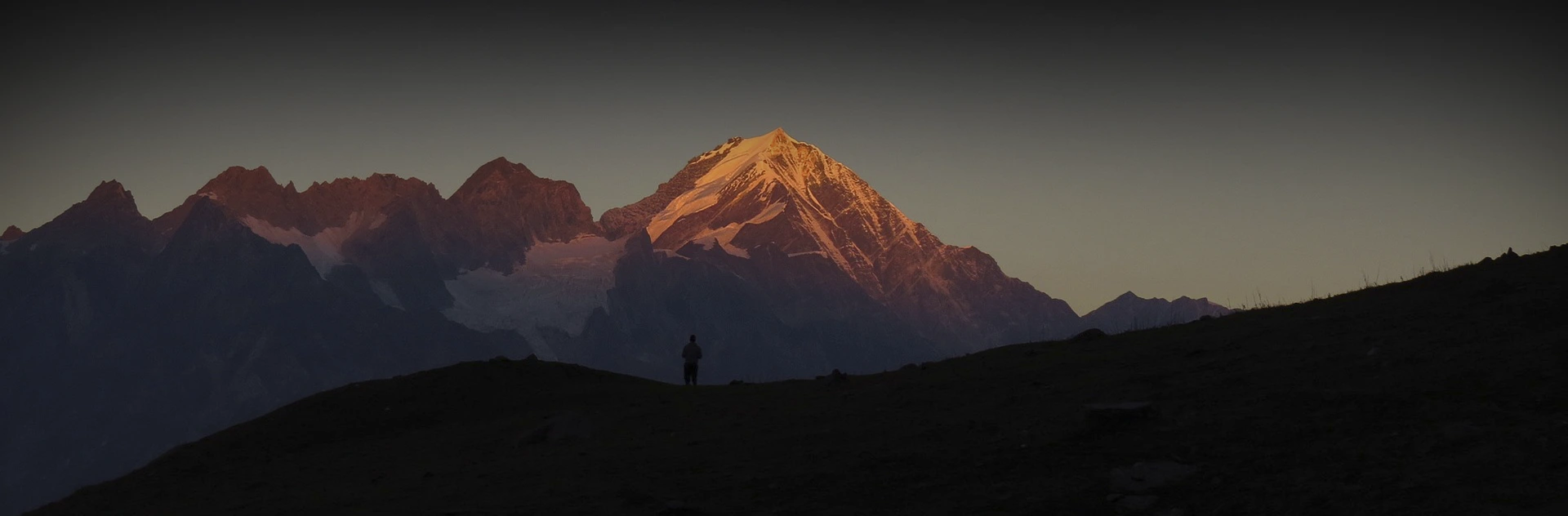
Pikey Peak Trek


 Trip Duration
  Group Size
  Max. Altitude
  Difficulty
 Meals
Meals - Breakfast
- Lunch
- Dinner
 Accommodation
 - Hotel
- Teahouse
 Activities
- Trekking
- Sighseeing
 Best Season
 - Spring (Mar-May)
- Autumn (Sep-Nov)
$ 550USD
- No. of Pax Per person
- 1 - 1 personUS$ 950
- 2 - 2 peopleUS$ 800
- 3 - 5 peopleUS$ 700
- 6 - 9 peopleUS$ 650
- 10 - 15 peopleUS$ 600
- 16 + people 9999 US$ 550
Total Cost:
US$ 950
- Private trip departures everyday
- No hidden cost
- Local based company
- We can help for big group
- Over 17 years of experience
- According to your needs, we can Customize the itinerary.

Itinerary of Pikey Peak Trek
| Day | Mode | Route Itinerary | Elev.(m) | Duration | Overnight | Included |
|---|---|---|---|---|---|---|
| 01 | Flight | Arrival day in Kathmandu | 1,300 | 30m | Hotel | Dinner |
| 02 | Tour | Tour in Kathmandu and trek preparation | 1,300 | 5/6 hrs | Hotel | Breakfast |
| 03 | Drive | kathamndu to Dhap Bazar (240 km) | 2,850 | 7/8 hrs | Guesthouse | B L D |
| 04 | Trek | Dhap Bazar - Jhapre ( 14 km) | 2,815 | 5/6 hrs | Guesthouse | B L D |
| 05 | Trek | Jhapre - Pikey Base Camp (13km) | 3,640 | 5/6 hrs | Guesthouse | B L D |
| 06 | Trek | Pikey Base Camp - Pikey Peak and trek to Junbesi (16km) | 4,065 | 8/9 hrs | Guesthouse | B L D |
| 07 | Trek | Rest day to visit Thupten Choling Monastery- back to guesthouse | 3,031 | 4/5 hrs | Guesthouse | B L D |
| 08 | Trek | Junbesi - Phaplu (14 km) | 2,380 | 5/6 hrs | Guesthouse | B L D |
| 09 | Drive | Drive from Phaplu to Kathmandu (280 km) | 1,300 | 9/10 hrs | Hotel | B L |
| 10 | Flight | Departure or extend days | ........ | ...... | .... | Breakfast |
Includes/Excludes
What's included
- Airport transfer service during pick-up and drop
- 3 star hotel in Kathmandu with Breakfast include according to Itinerary
- Sightseeing in Kathmandu with Guide and car with driver
- 3 meals ( Breakfast, Lunch and Dinner with 3 cup of tea/coffee a days)during a Trekking
- Teahouse/Lodge accommodation during the trek
- Experienced English-speaking government-licensed trekking guide and a porter
- Guide and porter’s salary, food, equipment, and insurance etc.
- All applicable National park and Local permits
- Kathmandu to Dhap loccal sharing jeep
- Phaplu to Kathmandu Local sharing jeep
- Sleeping bag and down jacket if needed (It’s refundable)
- Complimentary: T-shirt, Trekking map, and Water purification tablet
- Official expenses and government tax and VAT
- Certificate of Success from our agency to you
Optional Addons
(Available addons on extra cost)
- Deluxe hotel in Kathmandu
- Private jeep to Kathmandu to Dhap and Phaplu to Kathmandu
- Everest Experience flight or Everest Base Camp helicopter flight etc
- Any extra days in Kathmandu
What is excluded
- International flight tickets
- Nepal entry visa
- Travel and health Insurance which covers emergency Rescues and evacuations
- Personal expenses like snacks, alcoholic and non-alcoholic beverages,extra tea coffee Hot shower, bottled water, WI-FI, etc.
- Lunch, dinner, and an extra night at the Kathmandu hotel
- Tips for treks guide, and porter (it is expected)
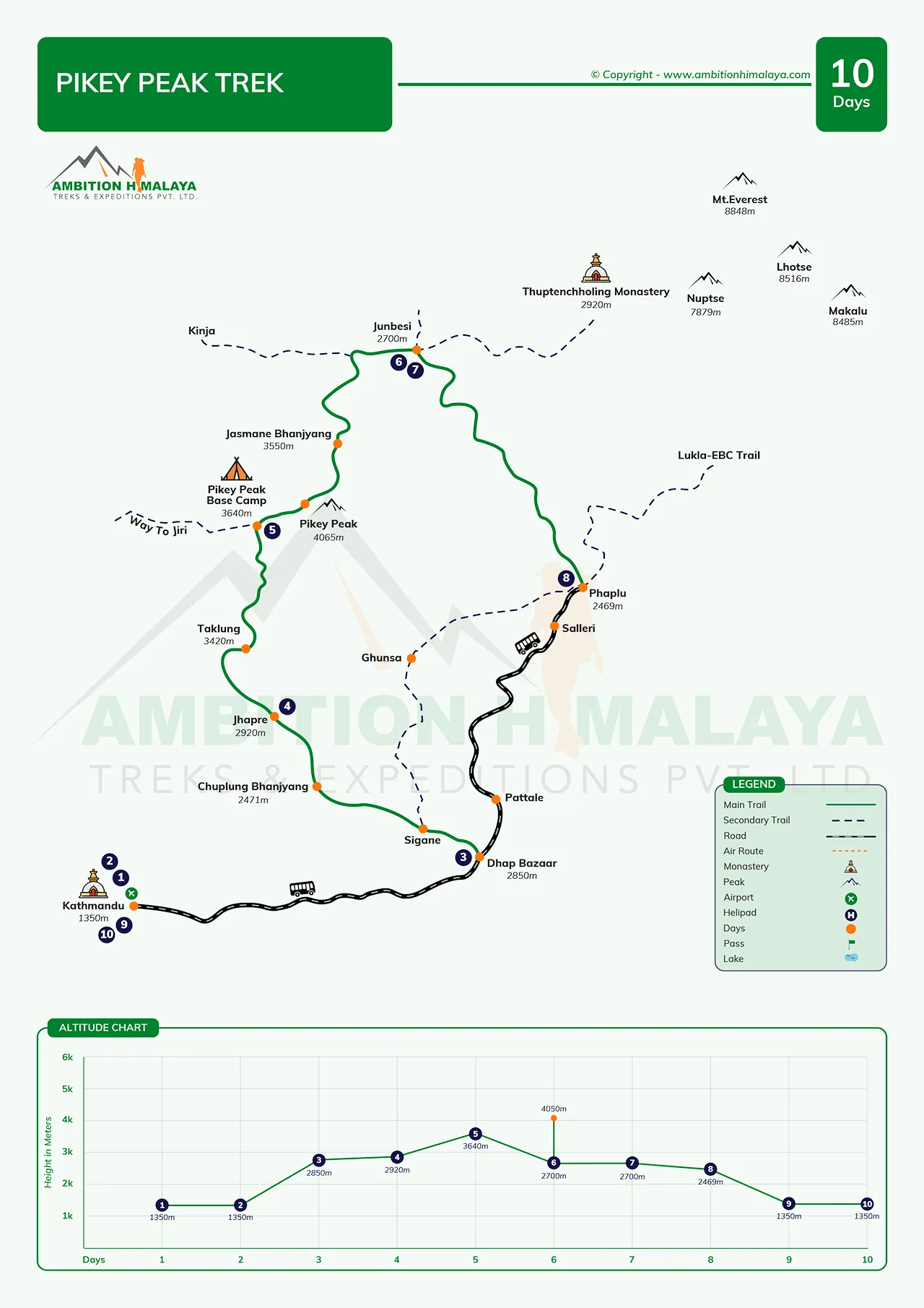
Route Map & Altitude Chart
Private Group Discounts Available
| No. of People | Price Per Person |
| 1 Pax | US$ 950 |
| 2 Pax | US$ 800 |
| 3-5 Pax | US$ 700 |
| 6-9 Pax | US$ 650 |
| 10-15 Pax | US$ 600 |
| 16 Over | US$ 550 |
Trip Information
Trek Difficulty and Fitness Tips
The Pikey Peak trek is considered easy-to-moderate. Days consist of 4 – 7 hours of walking on well marked trails. The maximum altitude of 4,065 m is lower than most of the treks in the Himalayas, and so the risk of acute altitude sickness is less. Nevertheless, you should prepare yourself with regular cardio exercise – hiking, jogging or cycling – and practice to walk on uneven terrain. Go for endurance instead of speed; take a light weight backpack on practice hikes, so that the real trek is more comfortable.
Do squats for leg and core strengthening as well as stretching for flexibility. During the trek, keep up a constant pace, rest frequently and drink lots of water. Porters will carry most of your baggage but keep your daypack light to conserve energy. With the right amount of preparation, beginners and families can easily do this Pikey Peak trek itinerary with ease.
Acclimatization & Altitude Sickness
Pikey Peak is at 4,065m, so altitude sickness is possible but rare on ascent as long as it is approached slowly. Our route follows an acclimatization day with a gradual ascent in altitude. We will begin at an altitude of 1,350 m in Kathmandu and drive up to 2,850 m in Dhap where we will stay one night below 3,000 m before climbing higher. On the day of the summit we will go down to Junbesi 2,700 m for the recovery process.
Just follow the golden rules of high altitude travel: ascend slowly, drink at least three liters of water every day, eat meals rich in carbohydrates and above all listen to your body. Avoid alcohol and smoking, which can make you dehydrated. Headache, loss of appetite, insomnia, dizziness and nausea are among the symptoms.
If you experience any symptoms, tell your guide immediately. Take rest and drink fluids, if necessary, go down a few hundred meters. For precautionary reasons carry Diamox (acetazolamide) after consulting your doctor. Oxygen and first aid kits are available with guides and at local health posts. With precautions and awareness, most trekkers complete the Pikey Peak trek without any altitude problems.
Accommodation and Meals
There are teahouses along the Pikey Peak trek for simple and comfortable accommodation. Rooms are twin sharing with beds, mattresses and blankets, some teahouses charge a small fee for hot showers. The teahouses are basic so take a sleeping bag liner and headlamp. Since blankets in many teahouses are thin, carrying a 3-season sleeping bag (instead of just a liner) is strongly recommended for warmth and comfort. In Junbesi and Phaplu, you can stay in some teahouses or small homestays with other trekkers.
Meals are filling and freshly prepared. Try typical Nepali foods, such as dal bhat (rice, lentils, and vegetable curry), noodles, fried potatoes, eggs and seasonal vegetables. Teahouses also serve Tibetan bread, porridge, momo and tea. A vegetarian meal is easily accessible. Have some snacks, such as energy bars and nuts, to add to the energy on long days. Water is available at teahouses; use water purification tablets or filter to avoid plastic waste.
A Typical Day on the Trek
Each day of the trek itinerary at Pikey Peak has a comfortable rhythm to it. We will wake around 6 am to the sound of roosters and enjoy tea while gazing at snow-capped peaks. Breakfast is served at 7-8 am prior to our walking. Rhododendrons bloom in spring and color the mountainsides; prayer flags crack out in the forests, at the ridges and across the villages.
A noon break offers an opportunity to rest and enjoy the local cuisine. After lunch, we will hike for a few more hours to our destination by mid-afternoon. Evenings are spent sitting around the stove, talking with fellow trekkers and getting an education about Sherpa life. We could sing a folk song with some locals or watch a sunset turn the Himalayas red. This is a relaxed routine that allows you to appreciate nature and culture daily.
Mountain Views and Animals
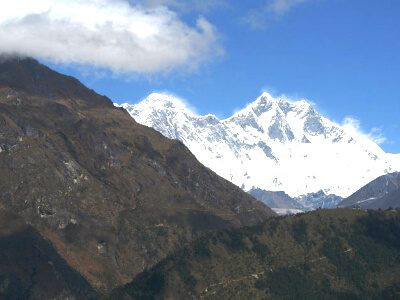
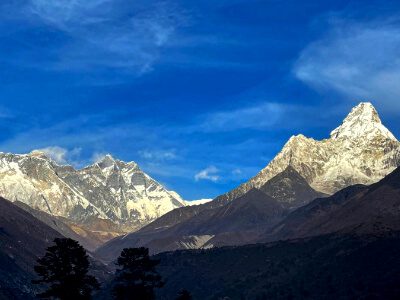
Pikey Peak Trek is famous for its stunning mountain views. From the top it is possible to see Mount Everest, Kanchenjunga, Makalu, Lhotse, and other eight-thousanders. Forests along the trail are filled with rhododendrons, magnolia and pine. In the spring, the hillsides are carpeted with crimson blossoms. You will be able to see Himalayan monal (the national bird of Nepal), musk deer, and langur monkeys. Bird lovers can keep an eye out for pheasants and eagles flying above the ridges.
The landscape shifts from terraced farmland near Dhap to alpine meadows around Pikey Base Camp. Viewpoints above the Jhapre and Pikey Peak sites provide incredible views of the sunrise and sunset. These natural highlights are what make each stage of the Pikey Peak trek itinerary visually rewarding.
Permit & Cost
Trekkers need several permits for the Pikey Peak trek itinerary. A TIMS (Trekkers Information Management System) card is mandatory and costs approximately USD 20 for group trekkers and USD 40 for individuals. Regulations may change, and sometimes TIMS is available only through trekking agencies, so costs may vary. You also need a Gaurishankar Conservation Area permit (around NPR 3,000) and a Solu Dudhkunda Rural Municipality permit (around NPR 2,000).
A Sagarmatha National Park permit is only required if you extend the trek north towards the Everest region. For the standard Pikey Peak trek, the required permits are Gaurishankar Conservation Area and Solu Dudhkunda Rural Municipality. Many agencies deal with permits as part of their package.
The trek cost varies according to the group size, transport and services. Packages typically range from USD 480–720. Shared jeep/bus transport keeps the cost at the lower end, while private jeep services and smaller group sizes push the price towards the higher end. Private treks with fewer participants and private jeeps may cost more than USD 800, especially for solo trekkers.
Prices usually include accommodation, three meals a day, a licensed guide, one porter for every two trekkers, permits, and a basic first aid kit. Confirm inclusions with your agency. Additional costs are personal snacks, hot showers, battery charging, Wi-Fi, tips, and extra nights. Carry enough Nepali rupees because there are no ATMs on the route
Best Time to Trek
The best seasons to do the Pikey Peak trek are spring (March to May) and autumn (September to November). During these months skies are generally clear, temperatures are mild and rhododendrons are in bloom. Autumn brings us stable weather, golden harvest and cultural festivals such as Dashain and Tihar.
Winter (December-February): While possible, be prepared for colder nights and occasional snowfall. Trails are quieter and views may be crisp. Monsoon time (June-August) is full of sudden rain, leeches and hidden mountain views. To travel at this time you should remember to enjoy the lush greenery and not be afraid of slippery paths. No matter what season, get up early in the morning to enjoy clear morning views.
Alternative Trekking Routes
There are several ways to customize your Pikey Peak trek itinerary. A popular alternative is the seven-day route from Dhap to Phaplu, similar to our main route. Adventurous trekkers can also extend the trail to include Dudh Kund, a sacred alpine lake south of the Pikey Peak or start from Jiri to enjoy the classic Everest approach taken by the legendary expeditions in the past.
Some packages shorten the trip to five days by not including the rest day at Junbesi, other packages include side trips to Goli village or the cheese factories near Pikey Base Camp. If you have extra time then you can combine the trek with Solu Dudhkunda which is nearby or you can further continue on to the Everest View Trek. Our twenty-day plan has buffer days for weather or personal exploration, which insure that you get a flexible and relaxing journey.
Optional Extensions (up to 20 days)
To make this a twenty day adventure, we would recommend adding extra acclimatization days and cultural excursions. Possible extensions include a visit to the mountain lake of Dudh Kund or trek to the quiet village Goli, a visit to the bustling market town of Jiri or relaxation in the relaxed surroundings of the Kathmandu Valley. These extra days allow for flexibility in weather delays and getting to immerse in more of what the Pikey Peak trek itinerary and surrounding region has to offer.
Health and Travel Insurance
Travel insurance is a must while trekking Nepal. Select a policy with coverage up to at least 4,500 m (though Pikey Peak is 4,065 m) to stay on the safe side, emergency helicopter rescue, medical treatment and cancellation of the trip. Read the fine print to make sure to include activities such as trekking; some policies exclude adventure sports.
Carry copies of your insurance documents as well as emergency contacts. In the unlikely case of serious illness or accident, your guide will arrange for evacuation and will liaise with your insurance provider. Although, Pikey Peak is considered safe and accidents are rare, insurance gives you and your family peace of mind.
Transportation
The Pikey Peak trek does not involve flights, but all travel is overland. You can choose private jeep for comfortable or shared local jeep/bus for economic travel. The distance from Kathmandu to Dhap Bazaar is approx. 8–10 hours by road, depending on route and conditions, covering 240–280 km.
From Phaplu to Kathmandu, the return trip also takes approx. 8–10 hours by road, covering 240–280 km depending on the route.Local vehicles leave from Machhapokhari bus station in Kathmandu, trekking agency will make transportation and stops for meals along the way. If you are sensitive to motion sickness, bring medication and sit in front of the vehicle.
Fitness and Preparation
Although no technical skills are required for the Pikey Peak trek itinerary, being in good physical condition increases your enjoyment. Start training a minimum of 6 weeks before departure. Walk regularly carrying a 5 to 7 kg backpack to get used to trek conditions; slowly build up the amount of time you walk to 4 to 6 hours. Cross train using running, swimming or cycling to develop aerobic fitness.
On the trek, move at a manageable pace and avoid rushing uphill. Drink plenty of water, stretch after each day’s hike and eat right to keep energy levels up. Most importantly, think positively – that is, enjoy the journey rather than the focus being on the summit. Your fitness preparation will help you enjoy every minute of this trek to Pikey Peak.
Guide and Staff
Hiring a guide is not required for the Pikey Peak trek, but it is a good way to make the trek safer and more culturally informed. Local guides are familiar with the terrain, handle logistics and offer insights into Sherpa culture. They are also responsible for monitoring your health and assisting you in case of emergencies. Porters carry 10-12kg per trekker, so you can walk comfortably.
Guides are licensed from Trekking Agencies Association of Nepal and speak English and local languages. Tipping is not mandatory, yet it is expected, and the average amount recommended is 10% of the cost of the trip. Solo trekkers with experience can try the route on their own, but if you hire a guide you are helping the local economy and are also certain to stick to the correct Pikey Peak trek itinerary.
Is This Trip Suitable for Beginners?
Yes. The Pikey Peak trek is known as one of Nepal’s easiest multi‑day treks. The lower elevation, moderate distance and well marked trails make it ideal for first time trekkers. Acclimatization and slow ascents further decrease physical stress. However, it’s still important for beginners to train, wear the right shoes, and follow safety tips.
Families with children and older travellers can also enjoy this trek as there are no technical sections and teahouses are available for comfortable rest. If you’re not experienced in trekking on your own, join a group or hire a guide to navigate the route and handle logistics.
Charging devices and Internet connection
Electricity on the Pikey Peak trek itinerary is limited. Teahouses have solar panels or generators to supply electricity and they may charge a nominal fee for charging batteries. Bring power bank and extra batteries for cameras and phones. There are no ATMs on the trail, so bring enough cash with you.
Mobile network is patchy Buy an NTC SIM card in Kathmandu for best coverage but even NTC signal can disappear above Jhapre. Some teahouses offer Wi-Fi for a fee but it is slow and unreliable. Embrace trekking as a chance to disconnect from digital distractions and immerse yourself in nature and local culture.
Visa and Permit
Most foreign travelers get Nepal visa at the arrival of Tribhuvan International Airport. Have a passport, valid for at least 6 months, and passport photographs. Tourist visas come for duration of 15, 30 or 90 days. You can also make an application online through the Department of Immigration.
Apart from the visa, you need trekking permits (mentioned above): a mandatory TIMS card, a Gaurishankar Conservation Area permit and a Solu Dudhkunda Rural Municipality permit. Personal documents: Copy your passport, visa and permits at all times because there are check-points along the trail.
Your Extra Expenses
Most of the basics are covered in your package, but you should plan on incurring further expenses. These are hot showers, recharging of batteries, Wi-Fi, soft drinks, snacks and alcoholic beverages. Tipping staff is customary; allow USD 10-15 a day to be split between your guide and porter. You may also spend an additional amount on souvenirs, contributions at monasteries or extra nights in Kathmandu. Weather delays or route changes can disrupt travel schedules, so it’s important to have contingency funds to cover delays and unexpected expenses.
Photography Spots & Best Views
The main attraction is the summit of Pikey Peak, arrive before dawn and get a photo of Everest glowing pink as the sun rises. Jhapre’s ridge is a sunset point and the panorama of Numbur Himal. Lamjura Danda offers a foreground of rhododendron trees with receding peaks. Golden roof of Thupten Chholing Monastery, Junbesi, with terraced hills in the background
Along the trail, prayer flags fluttering in the wind, friendly villagers and grazing yaks, all make for compelling subjects. To be able to maximise your shots, carry a camera with spare batteries and be sure to use the warm light of early morning or late afternoon. These photography hotspots make the Pikey Peak trek route a dream for landscape enthusiasts.

Good to know, before you travel
Want to learn more about this journey in-depth? Essential Trip Information includes a thorough itinerary, information for visa processing, Accommodations, Food , Acclimatization’s and pretty much anything else you could possibly need to know about this tour. Read more inside.
Frequently Asked Question
Our standard itinerary is 10 days. Optional extensions can make it up to 20 days.
The highest point is the summit of Pikey Peak at 4,065 m. This elevation is modest by Himalayan standards and reduces the risk of severe altitude sickness.
Yes. It is an easy-moderate trek, suitable for beginners and families. Basic fitness and determination are sufficient; no climbing experience is required.
You require a Gaurishankar Conservation Area permit and a Solu Dudhkunda Rural Municipality permit. A TIMS card is mandatory for all trekkers. A Sagarmatha National Park permit is only needed if you extend the trek north toward the Everest region.
Spring (March–May) and autumn (September–November) offer clear skies and stable weather. Winter is possible with colder temperatures, while monsoon season brings rain and leeches.
The risk is low due to gradual ascent. Stay hydrated, ascend slowly and rest if symptoms occur.
Teahouses and homestays provide basic rooms with shared bathrooms. Bring a sleeping‑bag liner and expect simple but clean facilities.
Yes. Most teahouses serve dal bhat, vegetable curry, noodles and other plant‑based dishes. Inform your guide about dietary preferences in advance.
Guides are not mandatory but highly recommended for navigation, cultural interpretation and safety. They also arrange logistics and support local communities.
Mobile coverage is limited. Buy an NTC SIM for the best signal, but expect no coverage above Jhapre and minimal Wi‑Fi. Bring a power bank for charging.
No. There are no cash machines along the trail. Withdraw sufficient cash in Kathmandu before you start the trek.
Pack layered clothing (thermal, fleece, waterproof jacket), trekking boots, a sleeping bag, trekking poles, sunglasses, sunscreen, water purification method and a first‑aid kit. Carry a power bank and headlamp as well.
Packages typically range from USD 480–720 depending on transport and services. Additional expenses include snacks, hot showers, Wi-Fi and tipping.
Yes. Insurance covering high altitude trekking and emergency evacuation is essential. Carry copies of your policy and ensure it includes medical coverage.
Absolutely, many trekkers link the Pikey Peak trek itinerary with the Solu Dudhkunda Lake trek, Everest View Trek or cultural tours in Kathmandu Valley. Our extended program offers buffer days to explore additional routes.
Quick Inquiry Form
 Read all reviews in Tripadvisor
$ 550USD
- No. of Pax Per person
- 1 - 1 personUS$ 950
- 2 - 2 peopleUS$ 800
- 3 - 5 peopleUS$ 700
- 6 - 9 peopleUS$ 650
- 10 - 15 peopleUS$ 600
- 16 + people 9999 US$ 550
Total Cost:
US$ 950
- Private trip departures everyday
- No hidden cost
- Local based company
- Over 17 years of experience
- Trip Customization