
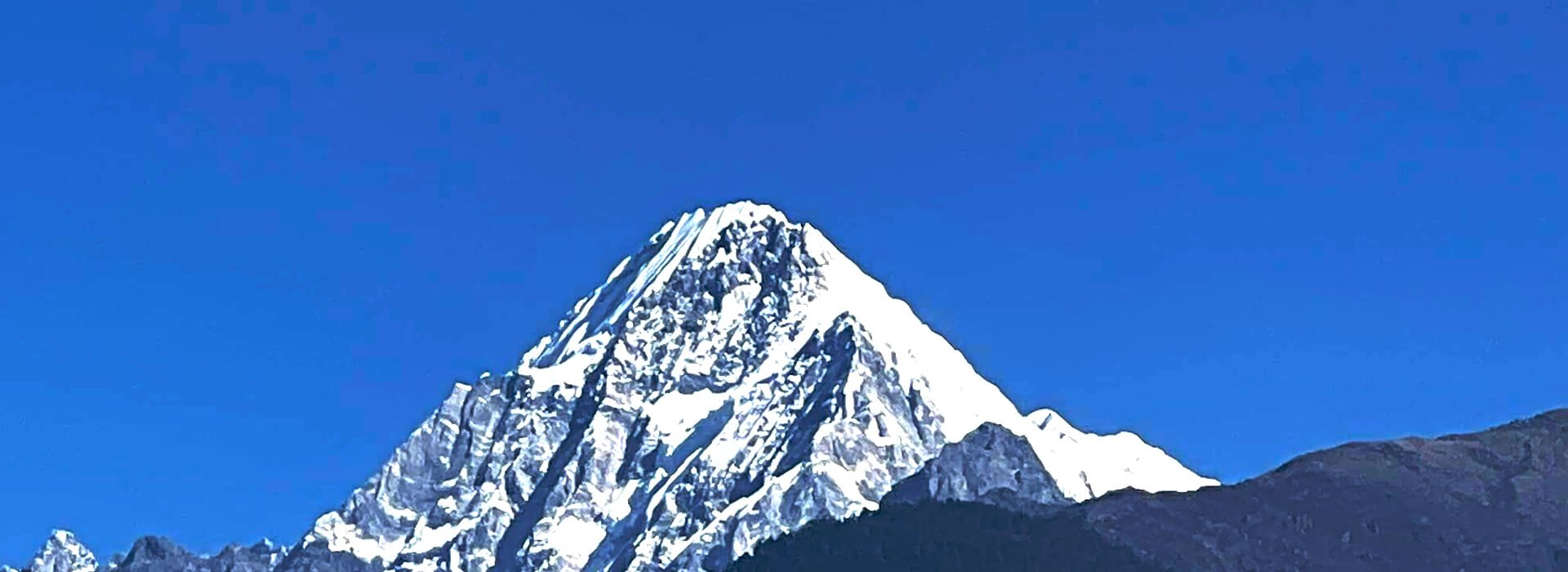
Langtang Valley Trek – 11 Days


 Trip Duration
  Group Size
  Max. Altitude
  Difficulty
 Meals
Meals - 11 Breakfast
- 8 dinner
- 8 Lunch
 Accommodation
 - 3 nights hotel in kathmandu
- 7 nights Lodge in trek
 Activities
- Trekking
- Sightseeing
- Hiking
 Best Season
 - Sep-Dec
- March-Apil
- May – June
$ 500USD
- No. of Pax Per person
- 1 personUS$ 750
- 2 - 2 peopleUS$ 650
- 3 - 5 peopleUS$ 600
- 6 - 9 peopleUS$ 550
- 10 - 15 peopleUS$ 530
- 16 + people 9999 US$ 500
Total Cost:
US$ 750
- Private trip departures everyday
- No hidden cost
- Local based company
- We can help for big group
- Over 17 years of experience
- According to your needs, we can Customize the itinerary.

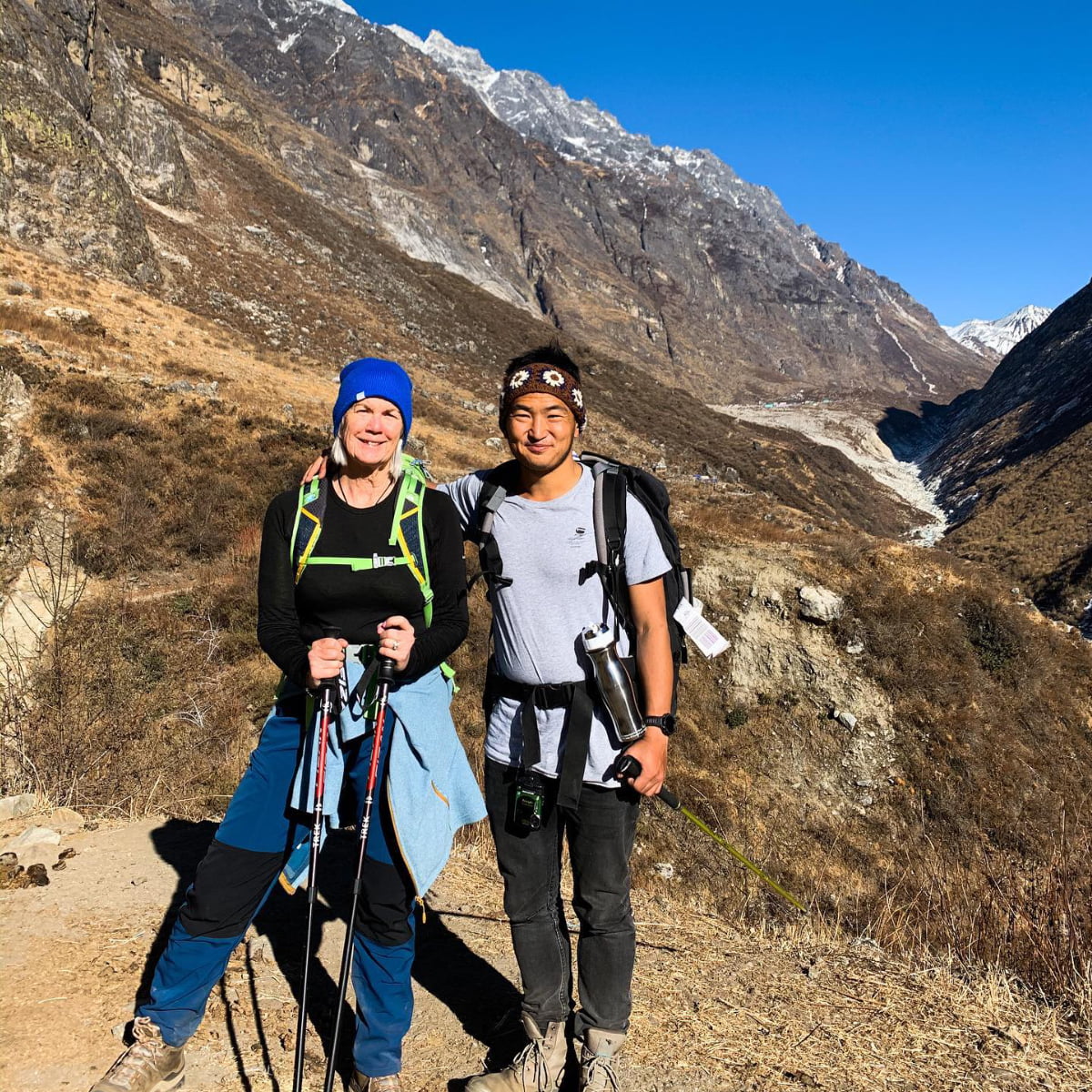
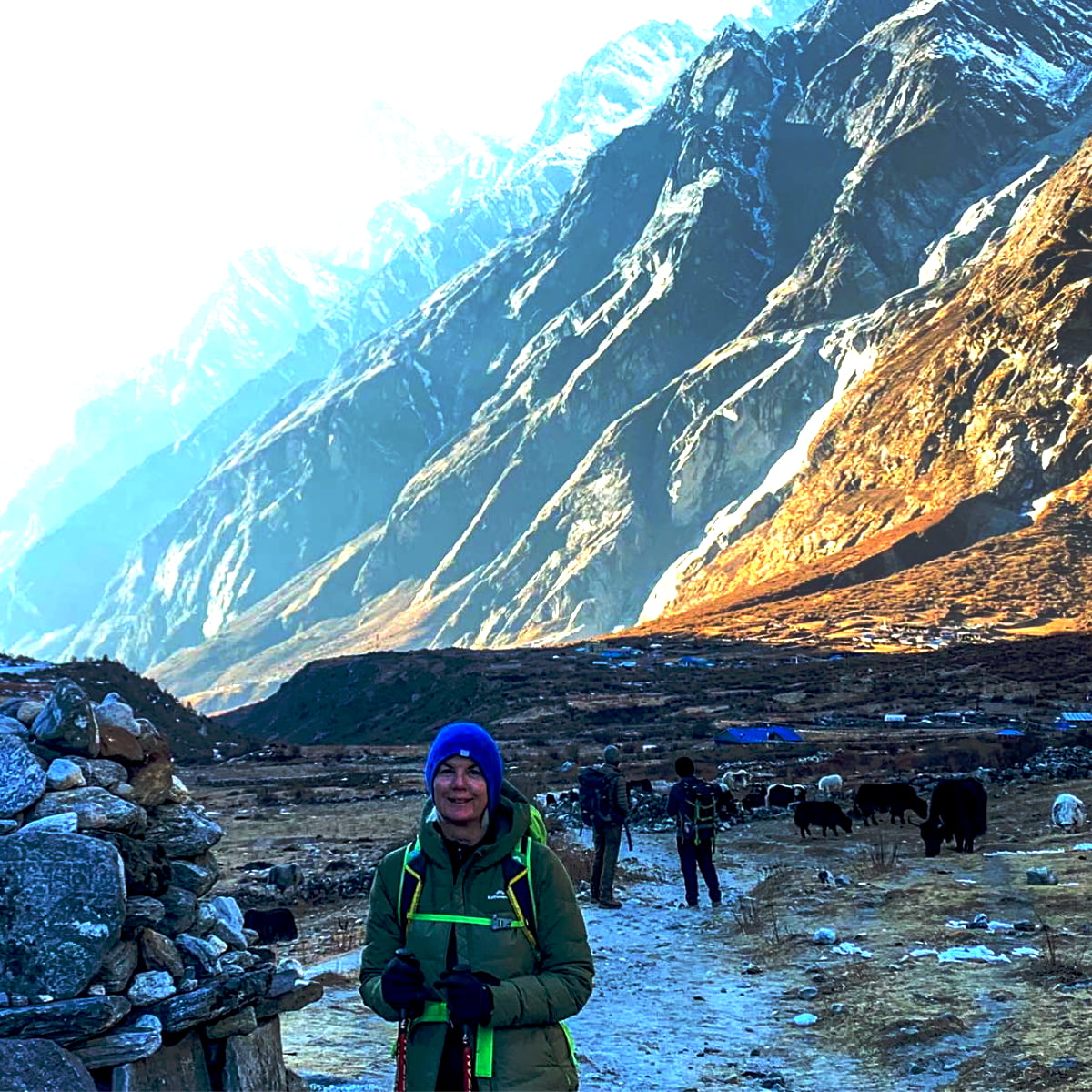
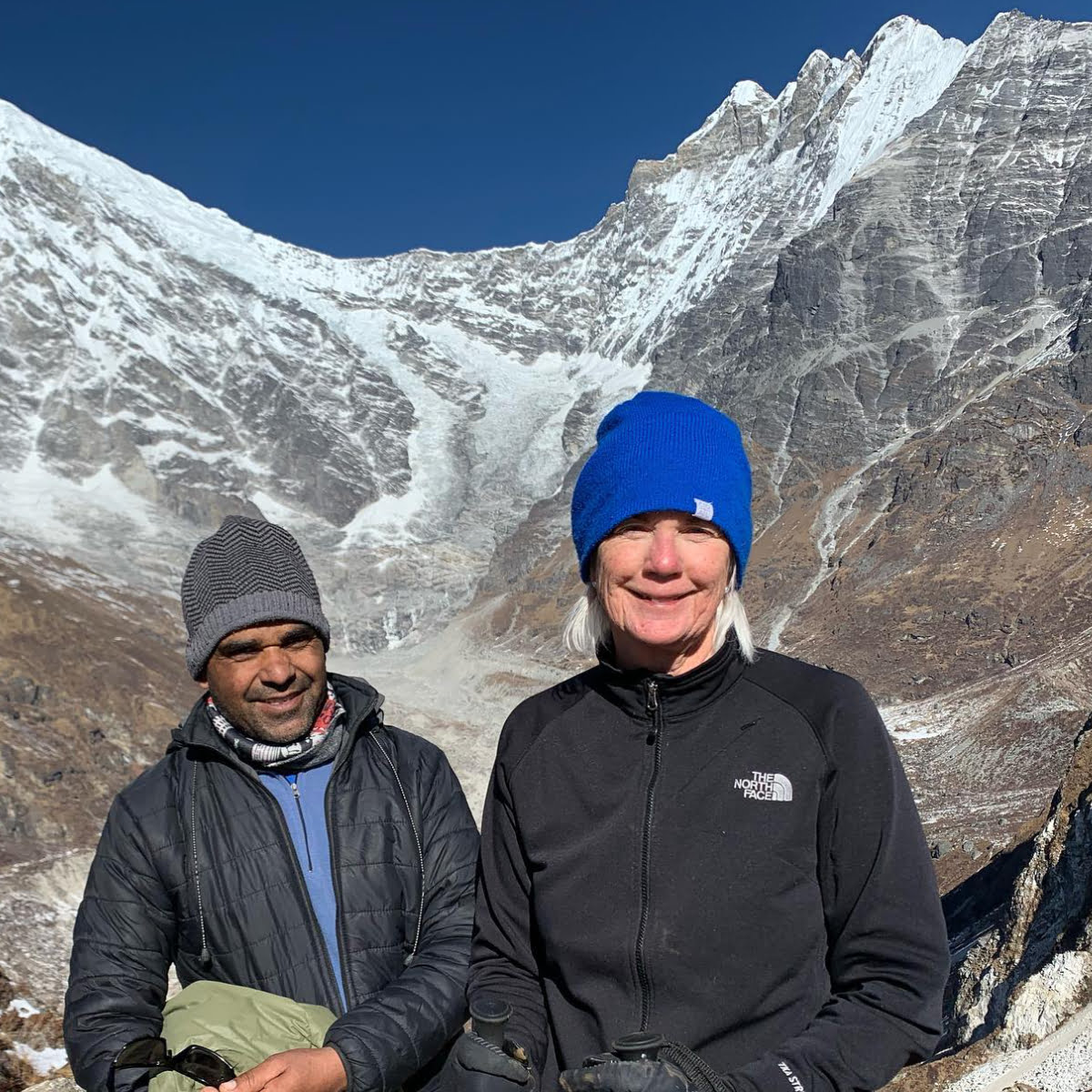
Langtang Valley Trek – 11 Days Photo Gallery
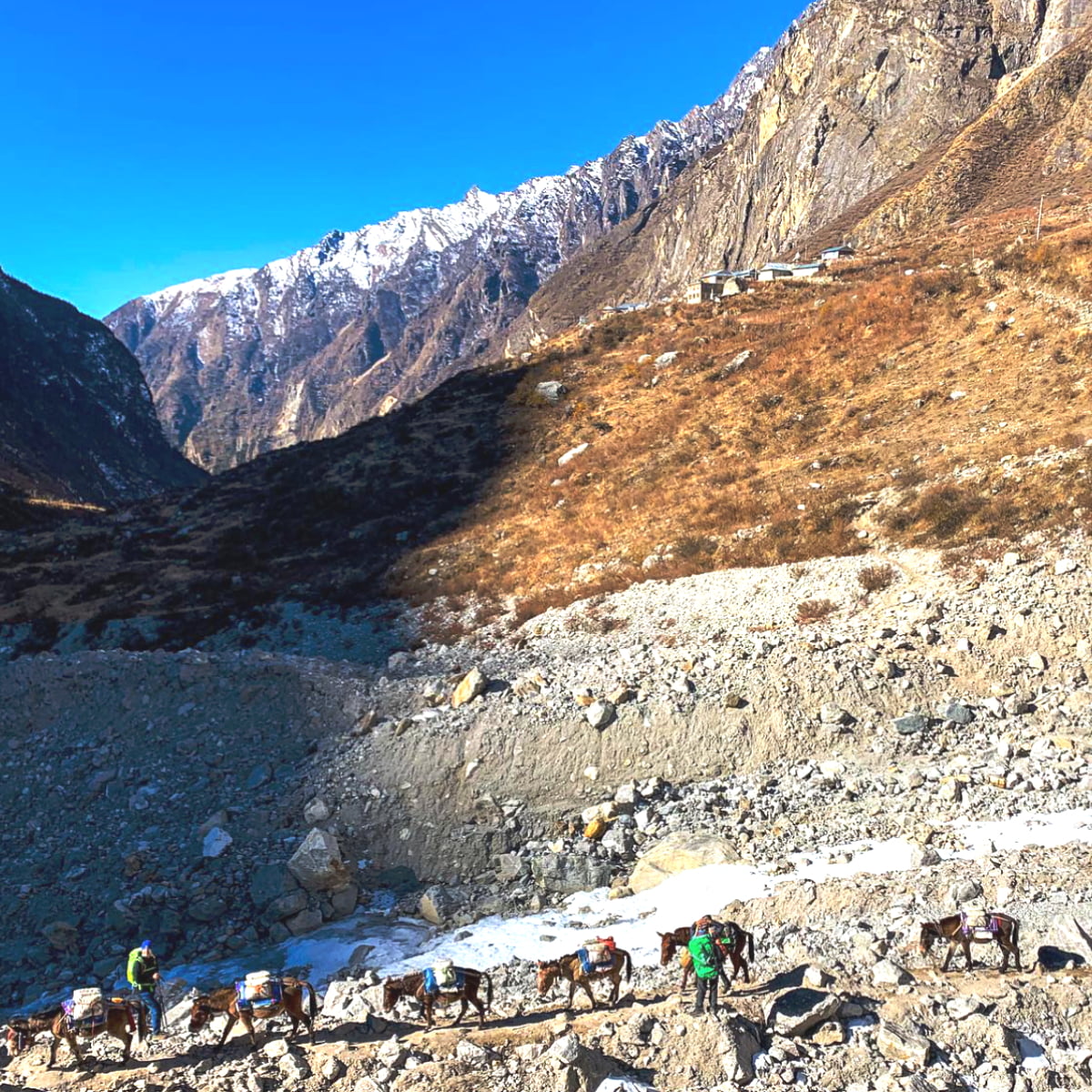
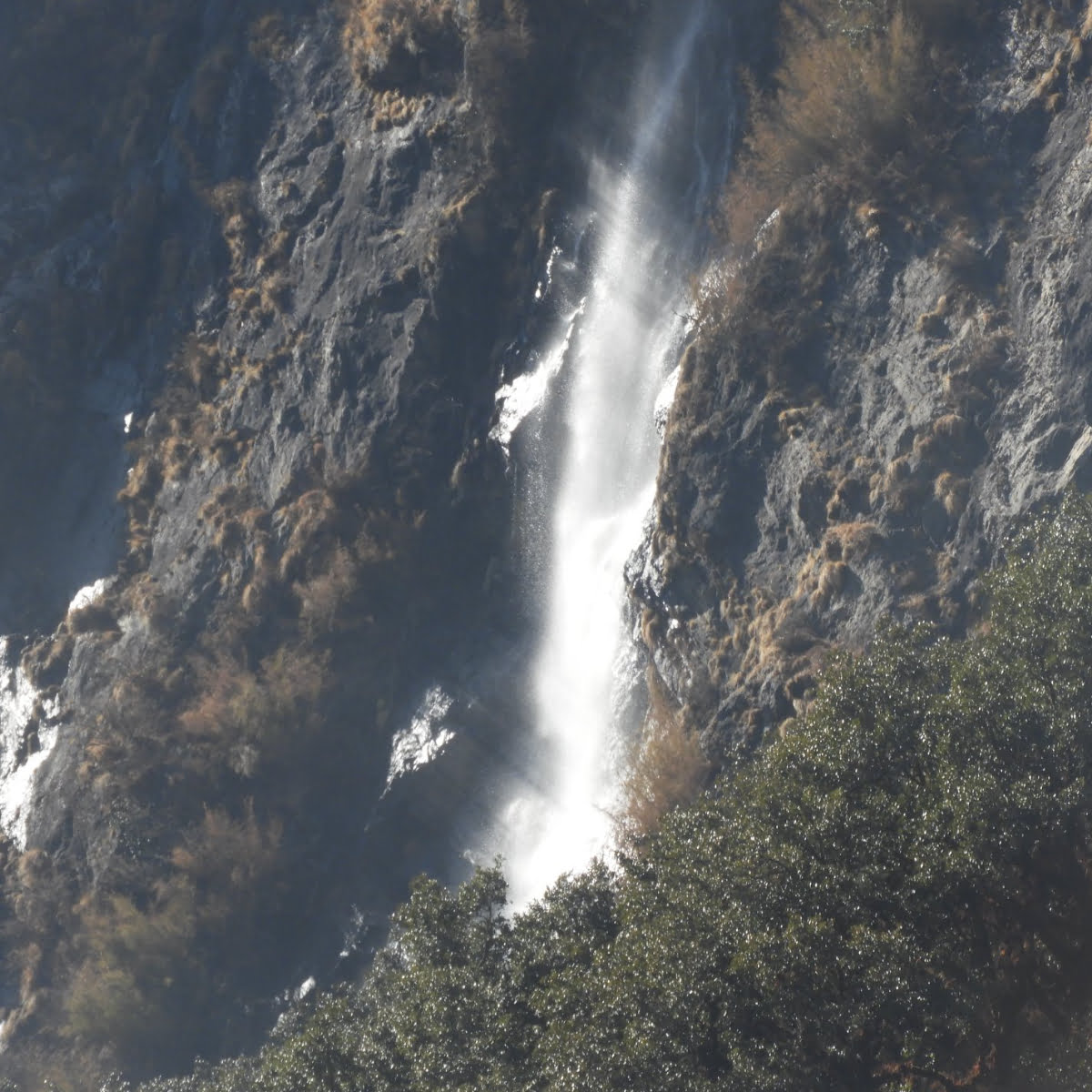
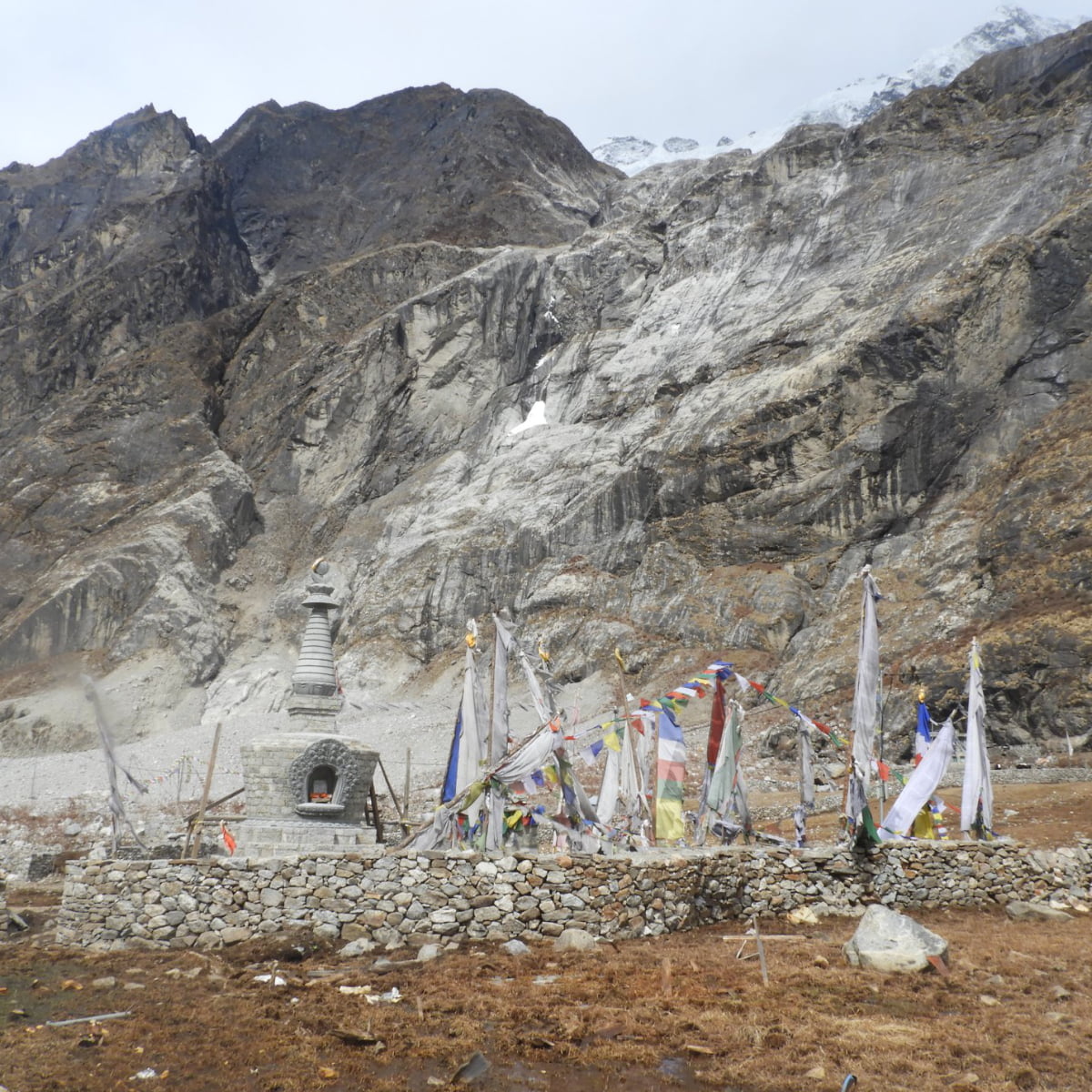
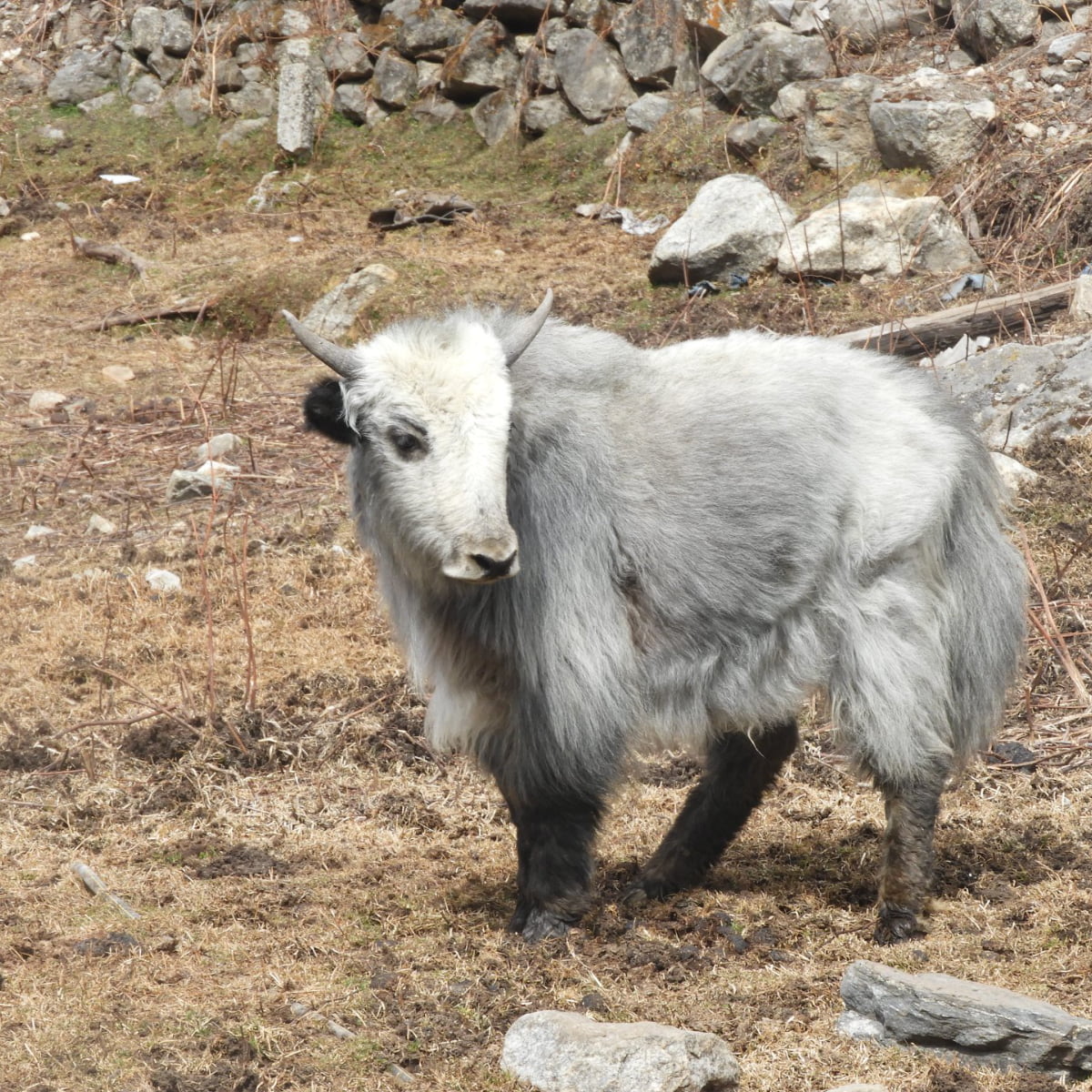
Itinerary of Langtang Valley Trek – 11 Days
| Day | Mode | Route Itinerary | Elev.(m) | Duration | Overnight | Included |
|---|---|---|---|---|---|---|
| 01 | Flight | Arrival in Kathmandu - Hotel | 1,300 | ---- | Hotel | Dinner |
| 02 | Tour | Tour in Kathmandu ( 4 Major Places) | 1,300 | 6/7 hrs | Hotel | B |
| 03 | Drive | Kathmandu - Syabrubesi | 1,420 | 7/8 hrs | Guesthouses | B L D |
| 04 | Trek | Syabrubesi - Lama Hotel | 2,350 | 5/6 hrs | Guesthouses | B L D |
| 05 | Trek | Lama Hotel - Langtang Village | 3,500 | 5/6 hrs | Guesthouses | B L D |
| 06 | Trek | Langtang Village - Kyanjing Gumpa | 3,860 | 3/4 hrs | Guesthouses | B L D |
| 07 | Hike day | Hike to Tserkuri | 5,000 | 5/6 hrs | Guesthouses | B L D |
| 08 | Trek | Kyanjin - Lama Hotel | 2,350 | 6/7 hrs | Guesthouses | B L D |
| 09 | Trek | Lama Hotel - Syabrubesi | 1,420 | 4/5 hrs | Guesthouses | B L D |
| 10 | Drive | Syabrubesi - Kathmandu | 1,300 | 7/8 hrs | Hotel | B L D |
| 11 | Flight | Departure from Kathmandu | ---- | ---- | ---- | B |
Includes/Excludes
What's included
- Airport pickup and drop-off services by private vehicle, including before and after the trek
- Accommodation in Kathmandu as per the itinerary, with complimentary breakfast
- All ground transportation by private vehicle in the city for sightseeing on the second day with a guide
- Kathmandu to Syabrubesi and back by local bus (optional private jeep)
- All required trekking permits and necessary paperwork
- Meals on full board during the trek (breakfast, lunch, and dinner)
- Accommodation in lodges or guest houses during the trek
- Trekking Guide [English speaking, eco-friendly, government licensed, Ministry of Tourism trained, First Aid trained] with salary, food, accommodation, transportation, and insurance
- Assistant trekking guide for groups of over 6 people with meals, accommodation, salary, and insurance
- Strong porters [1 porter shared between 2 paying people] with porter salary, food, lodging, transportation, and insurance
- Down jacket, sleeping bag, trekking map, Ambition Himalaya T-shirt, and duffel bag [the down jacket, sleeping bag, and duffel bag must be returned after the trek].
- First aid medications or medicines with the guide
- Necessary paperwork, government, and local taxes, and company service charges
- Complimentary welcome dinner in Kathmandu at a typical Nepali restaurant
- Certificate of Achievement signed by a director of the company and your guide
Optional Addons
(Available addons on extra cost)
- Private Jeep Kathmandu to Syabrubesi and Back
- Luxury hotel in Kathmandu
What is excluded
- International Airfares and Visa Fees: $30 for 15 days, $50 for 30 days, and $125 for 90 days
- Travel and Rescue Insurance, Emergency Evacuation
- Sightseeing entrance fees in Kathmandu Sightseeing
- Bar and beverage bills, cold drinks, mineral water, hot showers, telephone bills, laundry
- Extra activities than mentioned in the itinerary, extra porter charges
- Lunch and Dinner in Kathmandu [Meals not also included in the cases of early returns from the trips]
- Extra accommodation is required due to early arrivals, flight delays, natural disasters, etc.
- Tips and Gratitude for Guides and Porters
- Any services not mentioned in the “Services Included” section are not included unless specified on booking the trek.
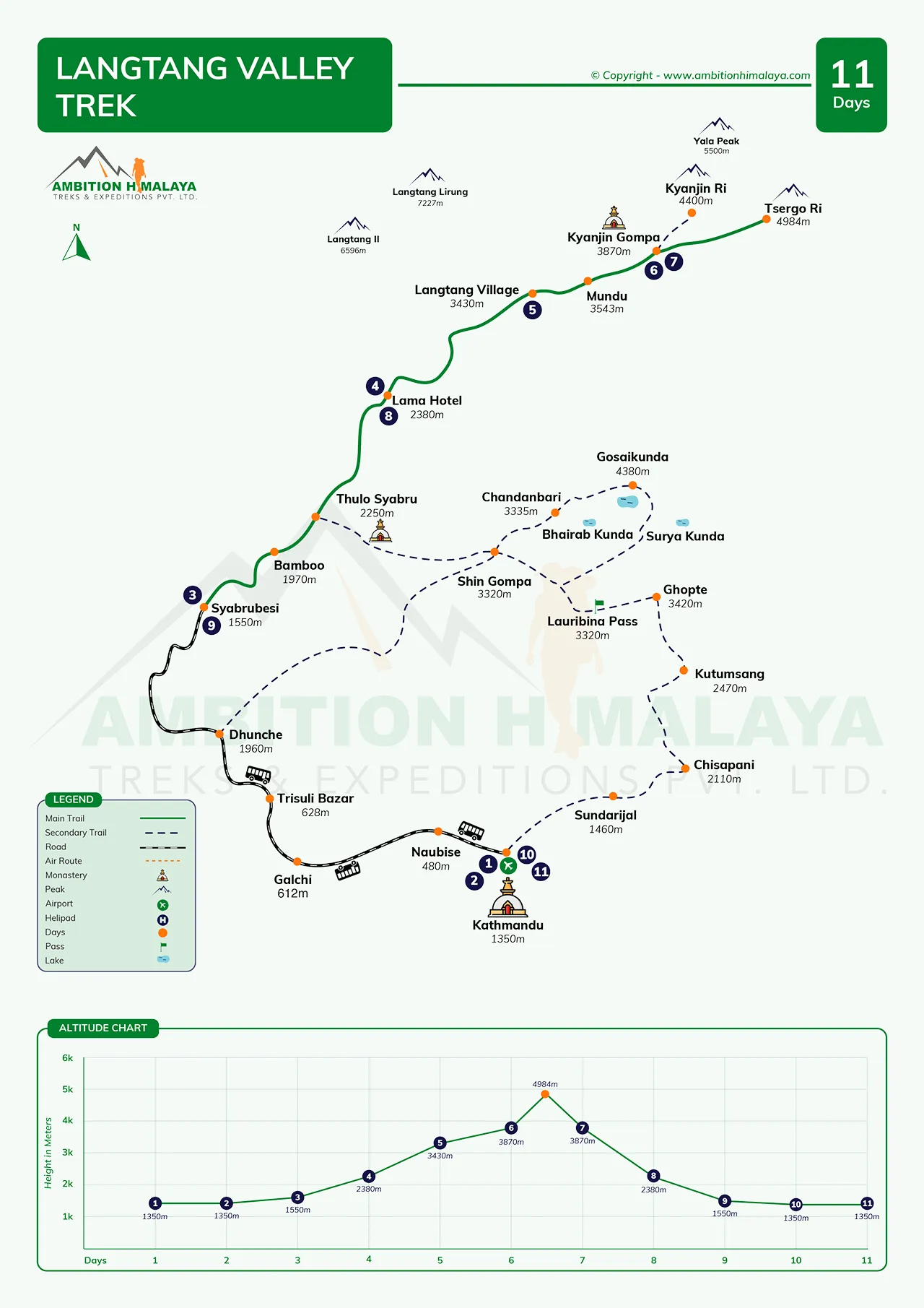
Route Map & Altitude Chart
Private Group Discounts Available
| No. of People | Price Per Person |
| 1 Pax | US$ 750 |
| 2 Pax | US$ 650 |
| 3-5 Pax | US$ 600 |
| 6-9 Pax | US$ 550 |
| 10-15 Pax | US$ 530 |
| 16 Over | US$ 500 |
Trip Information
Best time
When to visit the Langtang Valley Trek would be the most appropriate time to visit, according to the type of experience that you want to experience, since each season is unique. In general, spring and fall can be regarded as the most suitable seasons because the weather is stable, and the mountains can be seen.
The Langtang Valley trek is best done during spring, which is from March to May. The pathways are filled with rapping rhododendrons, wild flowers, and greenery. The climate is not harsh, and there are clear views of Langtang Lirung and the other mountain systems, and wildlife is seen more often. Trails are pleasant, but afternoons may be a little warm below.
From June to August, summer or Monsoon has green landscapes, running rivers, and reduced trekkers. The mountains appear to be fresh and green, and when it is raining heavily, the trails can be muddy and slippery. Some clouds conceal sight, and leeches can be a problem.
The most favored season when one does the Langtang Valley trek is in autumn, which is between September and November. There are clear skies, good visibility, and fresh air that give breathtaking views of the mountains. The trails are clear, and festive villages are a nice cultural detail, although there can be heavier traffic.
The winter season, which begins in December to February, would provide solitary paths as well as snow-trelled landscapes. Although the views are breathtaking, the weather at higher altitudes is chilly, and snow points can make hiking difficult; and should be well prepared.
Elevation and Distance
Langtang Valley Trek is a moderate trek of the Himalayas that has a gradual increase in height, and a good balance between the driving and walking distance, hence it is suitable to accompany the trekkers with a moderate fitness level and proper acclimatization.
Kathmandu is the start and end of the trek, which requires a low altitude of 1,400 meters. The trek itself begins after a spectacular drive at 1,420 m at Syabrubesi. This is where the trail will slowly wind up through forested trails and river valleys to Lama Hotel (2,350 m) and to Langtang Village (3,500 m).
The greatest number of stays is at the Kyanjing Gompa (3,860 m), a lovely alpine camp encircled by snowcapped mountains. The maximum point of the trek is the Tserkuri Viewpoint at 5,000 meters, where the trekkers visit it as a hike day to acclimatize and have a view of the mountain.
Physically, the total physical distance that the Langtang Valley trek covers is about 60-65 kilometers round trip, divided into various days of the trek, with the daily distance of 3 to 7 hours.
The distance that the driving covers is Kathmandu-Syabrubesi- Kathmandu, of approximately 260- 300 kilometers on roads. Such slow incremental upward progress and distances that can be handled make the journey worthwhile, but not impossible.
Difficulty and Altitude Sickness
The Langtang Valley Trek is regarded as a moderate hiking trail, which is only suitable for any trekker with fair fitness and a positive attitude. The routes are easy to follow, and none require technical climbing, but walks (5-7 hours of daily walks) with stone stairs and constant upward moves may be challenging.
The gradual ascending rate is such that the Langtang Valley trek is suitable for beginners who have proper preparation of basic hiking practice and endurance training before they come.
One of the primary issues of this trek is elevation sickness that can occur because of the rise in altitude over 3,000 meters. Between Langtang Village (3,500 m) and Kyanjing Gompa (3,860 m), air values decrease, and such symptoms as headache, dizziness, nausea, lack of appetite, and fatigue can occur. Going up to Tserkuri (5,000 m) is optional if acclimatization and weather are good, and gradual speed.
Trekking pilgrims are expected to walk slowly, take lots of fluids, avoid alcohol, and take rest days seriously to minimize the risk of encountering altitude sickness. It is necessary to be properly acclimatized, listen to your body, and descend right away in the event that the symptoms deteriorate.
Through proper planning and awareness, the majority of the trekkers go through the trek without any trouble and become part of the beautiful mountain landscape.
Maximum and Minimum walks per day
The Langtang Valley Trek has a moderate-paced itinerary with different walking hours on a day, which allows the trekker to acclimatize to the environment and the elevation. The walking time per day usually spans between 3 and 7 hours, depending on the gain of elevation, state of the trail, and the acclimatization requirements.
Peak walking days are experienced when trekking routes are lengthy, like Lama Hotel to Langtang Village and Kyanjing Gompa to Lama Hotel, with the trekkers taking about 6 to 7 hours of walking.
The days are concerned with constant ascending or descending through forests, river valleys, and alpine scenery. Another hard day is the walk to Tserkuri (5,000 m), which is a 5 to 6-hour round trip, and the most physically difficult day of the trip because of altitude, not distance.
The day of the minimum walking is less and is aimed at getting used to and resting. The walk between Langtang Village and Kyanjing Gompa is 3 to 4 hours, thus giving an option to relax and sightsee. In the same way, the last downhill walk from Lama Hotel to Syabrubesi takes approximately 4 to 5 hours.
The Langtang Valley trek thus covers around 45- or 55-hours walking; this is comfortably distributed among the days of the trek, and thus can be managed, yet still rewarding.
Foods and Drinks
Food and beverages of the Langtang Valley Trek are to serve appropriate nutrition and energy, comfort during the various walks, and in Kathmandu, as well as on the trekking routes.
Kathmandu food is also flexible, and the hotel serves a free breakfast. Breakfast is generally made out of things like eggs, bread or toast, butter, jam, pancakes, porridge, cereals, fruits, tea, and coffee. The city lunch and dinner are not included, and the trekkers get to choose from numerous varieties of restaurants to suit their preferences.
Food is served during the trek on a full-board basis, that is, breakfast, lunch, and dinner daily. Breakfast is usually consumed as porridge, Tibetan bread, chapati, eggs, pancakes, or muesli with a cup of tea or coffee.
One can find lunch and dinner comprising of dal bhat, noodles, fried rice, pasta, soups, momos, potatoes, and vegetables in season. These are meals that are prepared fresh in the local lodges and are filling and nutritious, especially during trekking days.
To ensure good health and acclimatization, it is highly advised that trekkers should avoid meat and alcoholic drinks, particularly at higher altitudes. Any other food and beverages other than BLD, like snacks, bottled water, soft drinks, chocolates, or additional hot drinks, shall be bought separately and are not part of the package.
Accommodation
The accommodation in the Langtang Valley Trek is easy, comfortable, and suitable for the trekkers, as per the itinerary, from Kathmandu to the mountain villages. Kathmandu lodging will be done in a comfortable hotel, on a twin-sharing basis, as listed in the itinerary.
These hotels are typically in tourist spots and offer good facilities like private rooms that are clean, attached bathrooms, hot showers, Wi-Fi, and electricity. It has a free breakfast to help the trekkers begin the day with a fresh mind before sightseeing or travelling.
The trek is accommodated in local lodges or guesthouses, otherwise referred to as teahouses. Rooms are simple but comfortable, mostly with twin beds, a mattress, a pillow, and a blanket.
Washroom services are different in different places; the low-altitude villages usually have attached or shared western toilets, whereas high-altitude places have shared squat or primitive toilets.
Most lodges have a stove or a fireplace in the dining area to heat up, particularly in colder areas such as Kyanjing Gompa. The bedrooms seem to be mostly not heated, and thus a warm sleeping bag is advised.
Hot showers can be found in some lodges, which are either solar- or gas-heated and are often charged an additional fee. In general, accommodation is clean and safe and is geared towards an enjoyable trekking experience.
Alternative Routes
The Langtang Valley Trek has various other options to other routes that trekkers may use to continue their adventure, visit the remote regions, or experience other sceneries and cultural values. They can be included in the main route based on time, fitness, and interests.
Another route that has become very popular is the Langtang-Gosaikunda-Helambu trail, which proceeds further to the holy Gosaikunda Lakes to the Kyangin Gompa or Langtang Village.
The track traverses the high passes and provides beautiful alpine landscapes, religious importance, and a more profound cultural experience with the Tamang and Sherpa people. It is harder as it has high elevation and extended days of trekking.
The other alternative is the Tamang Heritage Trail, which can be complemented with the Langtang Valley Trek. This path is oriented towards the Tamang villages, local culture, ancient monasteries, and the natural hot springs of Tatopani. It is a little bit lower and offers a cultural experience with fewer people.
A pleasant excursion for adventure trekkers is a hike to Langshisa Kharka by Kyanjing Gompa. The valley is remote and has spectacular glacier scenery and pristine landscapes that are very suitable for people in need of privacy.
These side tracks enable the trekkers to tailor the Langtang Valley trek to suit them by either extending the trek, making it more difficult, or even more culturally oriented.
Can a beginner join this trek?
Yes, a beginner will be sure to participate in the Langtang Valley Trek because it is one of the friendliest treks in Nepal. The path is clear, secure, and does not involve any technical climbing. The Langtang Valley trek could also be enjoyed by first-time trekkers who, with some preparation, could pass through the valley and appreciate the beauty of nature.
The itinerary will be gradual, and its altitude will be increased as a way of enabling the body to adapt. The walking hours are moderate with an average of 3 to 7 hours per day, with frequent rests and acclimatization hikes at high altitude. This alleviates the danger of altitude sickness and makes the walk easy for beginners.
There is the issue of physical fitness, and the beginners do not require high-level training. The normal walking, light hiking, stair climbing, or cardio exercises, which can be done in a couple of weeks before the trek, are quite enough. Attitude, mental preparedness, and the desire to walk at a slow pace are also significant factors.
Lodges have comfortable accommodation, hot meals, and clear paths that guide the beginners through the trek. Under the guidance and with correct hydration and safety precautions, novices will be able to successfully make the trek and get to admire beautiful mountain scenery, local culture, and have a rewarding Himalayan experience.
Preparation and Fitness
The main thing in the Langtang Valley Trek is to have proper preparation and fitness in order to enjoy the trek comfortably and safely. In spite of the fact that the trek is said to be moderate, good physical preparation serves to diminish fatigue as well as reduce the chances of altitude-related complications, particularly in the case of first-time trekkers.
When exercising preparation, put more emphasis on cardiovascular exercises like brisk walking, jogging, cycling, or swimming at least 3-4 times a week, and begin a few weeks before the trek.
Walking over rough surfaces, walking up a staircase, or carrying a lightweight backpack will assist in tightening the leg muscles and also enhance stamina. Balance and recovery during long walking days can also be achieved with core and flexibility exercises, such as stretching or yoga.
It is also vital to prepare mentally. The Langtang Valley trek is characterized by several consecutive walking days, primitive mountain services, and fluctuating weather conditions. Preparations of the mind to work with a simple accommodation, less comfort, and slow walking will make the experience better.
Trekkers are also supposed to bring the right trekking equipment, which includes: hiking boots that are worn out, warm clothing, a rain jacket, and a sleeping bag. It is necessary to get rest and eat well before and during the trek and remain hydrated. With suitable fitness and preparation, the trekkers can easily go through the adventure and enjoy the scenic Himalayan view to the fullest.
Gadget charging, Internet, and Communication
When doing the Langtang Valley Trek, one has to think ahead and keep devices charged because the mountain is a remote location. In Kathmandu and bigger villages, one can expect some modern facilities; however, in lodges and guesthouses towards the heights, there is limited electricity and internet connection.
In Kathmandu, hotels are well equipped in terms of Wi-Fi and power outlets; thus, a traveler does not have to worry about charging phones, cameras, and other gadgets. Most lodges or guesthouses along the trekking path offer charging facilities charges normally at a small fee.
There is a possibility of charging options involving a few hours in the evening, and power outages; therefore, it is advisable to have a power bank or solar charger to save the day.
The internet penetration in the Langtang area is primitive. There are lodges with Wi-Fi in communal places, although the speeds are slow and the connections are always problematic. Some villages, like Syabrubesi, Lama Hotel, Langtang Village, and Kyanjing Gompa, have coverage of mobile networks with weak and intermittent signal strength.
To communicate, travelers can use the local SIM cards to make calls and send messages where they have coverage. Mobile signals are usually unavailable, and only satellite phones are valid in remote places that are beyond Kyanjing Gompa.
The prepaid charge for charging gadgets and maintaining contact will help the trekkers in the Langtang Valley trek to be in touch and have the full Himalayan experience.
Permit
In the case of the Langtang Valley Trek, the required permits are an important aspect of the planning, though these are not something that the travelers need to be concerned with since all the necessary permits are a part of the trekking package. The permits play a key role in the legal access to the Langtang region and also in conservation work in the region.
The Langtang National Park Permit (LNP) is the primary permit that is needed to undertake the trek. The LNP permit will enable trekkers to visit and hike in the safeguarded Langtang National Park, which will conserve the nearby flora and fauna and culture.
In our package, permits are made and fixed beforehand, hence one can concentrate fully on their trekking experience without thinking about the administration. We do the administration, bills, and the governmental sanctioning, and make sure that when you come to Kathmandu, all the paperwork and payments are in order and legal.
The fact that all permits are included too will ensure a pleasant trekking experience since you will not experience delays and huddles at checkpoints when on the trail. Being a first-time trekker or a seasoned adventurer, the Langtang Valley trek is much more fun and relaxing when everything has to be sorted out beforehand.
Transportation
The Langtang Valley Trek has simple transportation that is aimed at facilitating ease and comfort during the process of going to the trailhead and getting back. This trek starts in Kathmandu, where the travelers are ferried to Syabrubesi, where the trek starts.
The road distance between Kathmandu and Syabrubesi is around 120 kilometers, and the road journey can be completed in 7 to 9 hours. Local buses are also available to the budget-conscious, and they will give one a genuine experience of riding through the picturesque countryside. Buses are simple yet secure and enable the passengers to have a view of terraced fields, rivers, and hillsides along the way.
To be more comfortable, tourists may choose to go by a personal jeep or automobile, which saves a lot of time on traveling, gives more freedom to make a number of stops, and offers a more comfortable and personalized experience.
On the trek itself, the walking is all on well-marked tracks, and no extra transport is employed until the return to Syabrubesi. Once the trek, one will be transported back to Kathmandu using a local bus or a personal vehicle, on the same route. Traveling privately is usually preferred by an inexperienced individual or when the individual wants to be comfortable after a few days of trekking.
Insurance
Although accommodation, meals, transportation, and permits are included in the Langtang Valley Trek package, travel and rescue insurance is not, and every trekker has to make his or her own arrangements.
Insurance is strongly encouraged because trekking in high altitude areas is associated with a number of hazards, which include accidents, sickness, altitude sickness, and emergency evacuation.
There should be a detailed trekking insurance policy which includes medical costs, helicopter evacuation, cancellation of the trip, baggage loss or damage, and delays. Helicopter evacuations can be very expensive in remote places such as Langtang, where the medical facilities are few, thus necessitating insurance as a sign of security and calmness.
Although the Langtang Valley trek is said to be moderate, there are unforeseen circumstances that can arise, including slips along the tracks, unexpected altitude sickness, or weather alterations.
Before the trek, a traveller is advised to have their insurance cover to cover high-altitude trekking, which is usually above 4,000 meters. One should also bring a copy of the policy and emergency contact numbers in case of an emergency during the trek. Insurance will help one have the confidence to enjoy the trek fully, besides making sure they are financially secure.
Finally, optional but a good measure, travel and rescue insurance is a wise move for all the trekkers engaging in the Langtang Valley trek because it ensures that any form of emergencies are dealt with in the most appropriate manner that does not affect the adventure in any way and does not cause unwarranted stress.
What to Expect
The Langtang Valley Trek is a memorable Tamang and Tibetan-influenced Himalayan culture experience as it offers spectacular mountain scenery, a rich cultural experience, and a variety of natural landscapes.
Trekkers should anticipate a moderate but satisfying experience that is good both for first-time hikers and experienced hikers. The route cuts across rich forests, terraces, and the traditional Tamang and Sherpa villages, giving a profound understanding of the local way of life, traditions, and even the hospitality.
Starting at Syabrubesi, the walk would slowly ascend through the beautiful valleys and riversides to Lama Hotel and Langtang Village, where the trekkers have an amazing view of Langtang Lirung and other snow-capped mountains.
One of the most interesting attractions is the picturesque alpine village of Kyanjing Gompa, encircled by glaciers and mountains, which has not only stunning nature but also cultural diversity. The alternative climb to Tserkuri Viewpoint (5,000 m) offers extensive Himalayan views and a feeling of achievement.
The trekkers are also likely to be greeted with well-developed trails, lodges, and guesthouses providing basic accommodation, full board meals, as well as chances to associate with warm-hearted local people. Walking takes between 3 and 7 hours daily, and it is not too hard, whereas with proper acclimatization, the experience is safer.
Others are road transport between Kathmandu and Syabrubesi and vice versa, purchase of trekking permits as part of the package, and safety by advising on travel and rescue insurance. Gadget charging, cell phone connection, and simple facilities can also be found, though very minimal in higher elevations.
The Langtang Valley trek has it all in terms of adventure, culture, and the beauty of nature, which is why it would be an excellent destination for anyone wishing to have an easy-reach yet a real Himalayan trekking experience in Nepal.

Good to know, before you travel
Want to learn more about this journey in-depth? Essential Trip Information includes a thorough itinerary, information for visa processing, Accommodations, Food , Acclimatization’s and pretty much anything else you could possibly need to know about this tour. Read more inside.
Frequently Asked Question
Spring (March-May) and autumn (September-November) are preferable because of clear skies, fine weather, and beautiful mountain scenery.
It is a medium hike, which is available to novice hikers with decent fitness. There is good marking of trails, and the walks taken every day are between 3-7 hours.
No, the beginners can be a part of the trek. It only takes proper preparation, gradual acclimatization, and basic fitness.
A Langtang National Park Permit (LNP) is needed. The trekking package consists of all the permits.
Insurance is strongly suggested in case of medical emergency, evacuation, and altitude-related complications.
During the trek, accommodation is in lodges or guesthouses, and during the Kathmandu trek, it is in hotels. The accommodation is simple with shared or attached bathrooms, heating in the dining areas (higher lodges), and hot showers where feasible.
Quick Inquiry Form
Trip Reviews

Based on 2
Reviews

Ruth
Australia
My Son and I used Ambition Himalaya to trek to Langtang Valley. Deliberately choosing September as our trekking time provided a perfect opportunity to enjoy the people and countryside of this very special location without too many other travelers. The owner Shishir Dhakal was very quick to respond to my Son’s emails during the organizing of the trek. He met us on our arrival in Kathmandu and took us out for a traditional Nepalese meal after finishing the trek. We had a porter ( Nete) and a guide
(Raj) that spoke English and we shared many a Conversation, laugh, and meal and left our trek with fond memories. Nete and Raj while friendly and professional set a great walking pace and lent a helping hand during some challenging walking times. My son used this company several years ago and we would both highly recommend you use this local company. To trek through this part of Nepal, eat local food, and stay in the guest houses run by locals certainly opened our eyes to the resilience and human spirit found in this very special part of the world!

Excellent
Adriana
Madrid, Spain
We were 5 members of a Family from Spain recently finished the Langtang Valley Trek, and it was an incredible journey. Shishir from Ambition Himalaya was a fantastic organizer for the trek. He answered me very soon of my every question. We were really happy for this Organization who provide us very good guide and good explanations of culture and mountains The paths were well-maintained, the people were warm, and the view was magnificent. I heartily endorse this expedition to anyone looking for a once-in-a-lifetime experience. One of Nepal’s most stunning locations, and I’m happy as also My family members. I 100 % recommend Ambition Himalaya, I sure everyone get good services from them.
Excellent
$ 500USD
- No. of Pax Per person
- 1 personUS$ 750
- 2 - 2 peopleUS$ 650
- 3 - 5 peopleUS$ 600
- 6 - 9 peopleUS$ 550
- 10 - 15 peopleUS$ 530
- 16 + people 9999 US$ 500
Total Cost:
US$ 750
- Private trip departures everyday
- No hidden cost
- Local based company
- Over 17 years of experience
- Trip Customization